Showing posts with label On Natural Dyeing. Show all posts

Saturday, July 1, 2017

The collected works of the Alexis, or The Secrets of the reuerend Maister Alexis of Piemont.


The secrets of the reverend Maister Alexis of Piemont : containing excellent remedies against diverse diseases, wounds, and other accidents, with the maner to make distillations, parfumes, confitures, dying, colours, fusions, and meltings ... by Girolamo Ruscelli; Translated by William Ward, The fourth part is Translated out of Italian into English by Richard Androse, Published 1595

This is the first edition containing all the four parts and each has a separate t.p. The first editions and text versions (copy/paste) are available at EEBO, Early English Books Online (restricted access).

Includes:
1558 The secretes of the reuerend Maister Alexis of Piemount 
1560 The seconde part of the secretes of Master Alexis of Piemont
1562 The Thyrde and last parte of the Secretes of the Reuerende Maister Alexis of Piemont
1569 A Verye Excellent and Profitable Booke

Read and download your copy at:
https://archive.org/details/secretsofreveren00rusc
https://ia800803.us.archive.org/24/items/secretsofreveren00rusc/secretsofreveren00rusc.pdf

Sunday, September 11, 2016

TO dye bones, woode, skinnes, leather & hogges brystles...

→To dye bones into a greene colour.
TAke a panne full of cleare water, and put into it a good greate piece of quicke lyme, leauinge it so the space of a  daye. The next daye morninge mingle it well together with a sticke, and so let it reste, and at none styrre it agayne, and likewise at night. The nexte mor|ninge folowinge, you shall straine it cleane oute and kepe it, in the meane time haue the bones that you will die in a readinesse, and boile them well in other com|mon water, wherein Roche Alome hath ben dissolued, and whan it hath boyled a good space, you shall take them out, and let them drie, than scrape them wel with a knife, and put them into the sayde lime water, and addinge to it some Verdegrise, you shall let them seeth well, and than take them out. And after you haue wy|ped and dried them, do with them what ye will, for thei will be very fayre: And in stede of the saied lyme water you may vse pisse, whiche wyll be of the like operation.

comments: quick lime is calcium oxide; roche alum is rock alum (hydrated potassium aluminum sulfate), verdegrise is verdigris (copper carbonate).

→Another maner howe to die bones, or Iuorye, into the coloure of an Emeraude.
TAke Aqua fortis separatiua, and put therin to fret and dissolue, as muche copper or brasse, as the water is hable with her force to dissolue and leuse: this doen, put in what peece of woorke you will, beynge fyrste cutte in the fourme that you will haue it, as beftes for kniues, penkniues, ynckhornes, images, or anye other thinge to youre fantasie, leaue them in it the space of a night, and thei shall be of the colour of an Emerande. Nowe, if in steede of copper or brasse, you didde put in Syluer, it woulde be the better.

comments: aqua fortis is nitric acid.

→To die bones redde, blewe, or of anye coloure you wyll.
87 FIrste boyle your bones in Alome wa|ter, than take quicke lyme water, or pisse, and in this water or pysse, you shall put Brasyll, Azur, or an herbe called Rub[...]a, which the Apoticaries call Rubramaior, and Rubra tinctorum, or Rubea tinctorum, wherewith they coloure wolle or skinnes, in Englishe Chickweede, or what other colour you wyll, and than seeth your bones or Iuozie therein, and they wyll take suche coloure as you put in.

comments: alome is alum; Rubia tinctorum is common or dyer's madder; Iuozie could be ivory.

→A very goodlie secrete to dye or colour woode, of what colour a man will, which some Ioyners do vse that make tables and other thinges of diuers colours, and do esteme it amonge them selues to be of suche excellencie, that one brother will not teache it another. 
TAke early in the morninge, newe and freshe horse donge, made that night, and take of the moysteste ye can gette, with the strawe or lytter and al, and laye vpon some little stickes layde a crosse one ouer|thwart another, and set some vessell vnderneth, for to receaue that shall droppe or fall from the sayde donge. And yf you can not haue inough in one morninge, doe the like two or three times, or as ofte as you wyll: than whan you haue wel dreamed out the water of this dong you shall put into euery pot of the sayed water, the big|nesse of a beane of Roche Alome, and as much gomme Arabick. Than stiepe what colour you will in it, vsing dyuers vessels, if you will haue diuers colours, and put in what pieces of wood you will, holdinge them at the fyre, or in the Sunne: and at eche tyme plucke out some pieces and laye them apart, leauinge the other in, for the lenger ye let them lie in the water, the more wyll the colour alter. And in this manner you shall haue a greate quantitie of diuers colours, the one cleerer, the other darker, and maye vse it to youre commoditie, so what vse you list, for they shall be coloured both within and withoute, so that they will neuer lose theyr colour, neither by water or any other thinge.

comments: roche alome is rock alum; gomme Arabick is gum arabic.

→To counterfeyte the blacke woode called Hebenus, or Hebenum, and to make it as fayre as the naturall Hebene, which groweth no where but in India.
ALl kynde of woode that is lyke vnto this Hebene, may be dyed black: but the hardest and the massiuest (as boxe and other lyke) are meetest for it, [Note: Sola India fert Hebenu~ ] and will be bryghter, and aboue all, the wood of a Mulbery tree, as well the white as the blacke, is the beste to be couloured, albeit the blacke be muche more for the pur|pose. Take than the saied wood, and let it lye the space of three dayes in Alome water, either in the Sunne, or a pretye waye of frome the fyre, vntill the water waxe somewhat warme: than take oyle Oliue, or Oyle of lyne seede, and put it in a little panne, wherein is the bygnesse of a nutte, of Romaine Vitriole, and as much Brymstone. This doen, seeth your woode in the sayde Oile a certaine space, and so shal you haue a thinge ve|ry darke of colour. And the lenger you let it boile, the blacker it will waxe, but to much boylinge burneth it, and maketh it bryttle, therfore both in thone and other you must be circumspecte, and vse discretion.

comments: hebenus is ebony (Diospyros ebenum); oyle Oliue is olive oil; Oyle of lyne seede is linseed oil; Romaine Vitriole is cupric sulfate, Brymstone is sulfur.

→To die skynnes blewe, or of the colour of Asure.
HAuinge fyrst well washed the skinne, and than wronge him, take the berries of wal|wort, and elder berries, and seeth them in water, wherein Roche Alome was dissol|ued, passe him once thorowe this water, & let him drie, than passe him again thorow the same wa|ter, and being wiped and dried againe, wash him with cleere water, than scrape out that water with the back of a knife, & once again passe it ouer wt the same colour, and let it dry, so shal it be of a very blew or Asur colour.

comments: Roche Alome is rock alum.

→To die skinnes in chickweede, called in latin Rubra ma|iore, or Rubra tinctorum, into a redde colour.

HAuing anoincted, washed, wronge, & layd abroad the skin, as is aforesaied, wete it with water that white wine lees and baye salt hath ben boiled in, and than wring him. Take than cre|uises or crabbe shelles (be they of the sea or of the riuer) burned into ashes, the whiche you shall temper with the said water of the lees and salt, and rubbe well the skinne therwith, than washe him well with cleere water, and wringe hym. This done, take ruddle tempered in water of lees, and rubbe the skinne well ouer and ouer with it, and than with the foresayde ashes, wasshinge, and wringinge it thre times. Finallye, after you haue wasshed him, and wronge him, if you thinke it be not well ynoughe, you shall geue him one dienge with Brasyll. The paste or masse of Rubra tinctorum, must be made with water that lees or tartre hath bene boiled in, and the sayed water must be luke warme, whan you make the paste of rud|dle, than leaue it so the space of a night. After this, put vpon the sayd Rubra tinctorum, a lyttle Alome, dragges, or lees, or Alome catinum, stieped in water. You maye also adde to it the colour of the shearing of scarlet, whi|che hath bene taken oute boylinge in lye, whiche is a goodly secrete.

comments: Rubia tinctorum is common or dyer's madder; lees (dragges) is the sediment in a barrel of wine and contains tartar; Alome is alum; Alome catinum is uncertain, could be burned tartar.

→To die skinnes Greene. [Note: Sap green is made with the berries of a Dogge berry tree ]
ANnoint the skinne, and wash him well with cold water, and than in hote water, and so wipe & drie him. This doen, take of the graines wherwt men the sappe (the decoction wherof shall be put in thende of this boke, with them of all other necessary thinges) and the sayde graynes or berries muste be verye rype, than put them in cleare water, couered a fingar heigth, put therein also Roche Alome, and geue theim onelye one wawlme on the fyre. This doen, strayne them out into some vessell, than take the skinne, and folde him in the middle, rubbinge him well on both sydes, with the said sodden graines, or berries, whiche remaine in the pan, and after with rawe Alome poulder. This doen, take the ashes of shepes donge burned, and wete it with the saied coloure that you strained into the sayde vessell, and rubbe the skinne wel on euery side, than cleere him againe of the saied graines, and washe him with cleere water, and set him to drie withoute wipinge him. Fy|nally cast on him two glassefulles of the sayde coloure, and it will be a perfecte greene.

comments: Roch Alome is rock alum; graines are most likely buckthorn berries, used to make sappe green (UV sensitive).

→Another waye to dye skinnes greene.
LEtte the skinne be annoincted, well wasshed, wronge, and stretched oute as before, than take of the same grai|nes and berries ye toke before, which you shall stampe and seeth in Roche Alome water, and geue the skynne twoo wypes ouer with this coloure, and so let it dry. After this you shal geue him one dying or colouringe of yellowe, made with the graynes, or berries of Nerprum, sodden in water and Alome, and a lyttle Saffron, and you shall haue an excellent greene.

comments: Alome is alum; nerprum is a yellow dye, as is saffron.

→To die the sayde skinnes greene another waye.
TAke the skinne, being annoincted, wasshed, and spredde abroade, dye and coloure him with the coloure made of sap greene, and put to it a few asshes wette in water, and so rubbe the skinne all about. And whan you haue washed and wyped hym againe, geue him one wype ouer with and Indian co|loure sodden in Roche Alome. And whan it is drye, lay on it of the foresayde yellow, and you shall haue a fayre and liuely greene.

→Another waye to dye skinnes of Asure coloure, and fayre.
TAke the skinnes of blacke grapes, and rubbe well your leather with all, vntill it waxe some|what blewe, and alsoo rubbe it well with the poulder of Indicum, then washe it, drye, and po|lyshe it. Than stiepe the Indicum in thicke redde wyne: and whan the skynne is washed, annoinct him with it, and you shall haue a fayre skinne asured blewe.

comments: Indicum is likely Chrysanthemum indicum, a known source of green dye.

→Another maner to dye skinnes Greene.
TAke rype elder berries, and the berries of wal|wort, and of sappe greene, and this well stam|ped, you shall put to it Roche Alome, as muche as you shall thinke good, but rather to muche than to little: than take the lye, and put into it the saied berries of sappe greene, and seeth them one waulme.
This doen, put in the berries of the walwort, or elder, and make them seeth also one waulme, than take them from the fyre, and let them coole, and after rubbe the skinnes with theim. Finallye, ye shall cast vpon them, the ashes of sheepes donge, rubbinge them well with it. After this, geue theim the couloured water that the saied graines or berries were sodden in, than take of the water with a curryers knyfe, and let them drye. And yf you nede to geue theim more coloure, than you maye put in more Indicum boyled, and it wyll be the better.

comments: Walwort is walewort or European dwarf elder.

→To die neates leather into a greene colour, as well in galle as in leaues.
POlyshe well the leather with a pom|meyse stone, annointe it well with oyle, and washe it: than take an vnce or two of galles stamped, and put it in hote water, leauing it so an hour, than straine it thorow a linen cloth, and put the leather into the same wa+ter, rubbinge it well with your handes, and leaue it so the space of an houre: and hauinge taken it out, wring it, and stretch it abroad, & tight it. Than take the grai|nes or berries of Nerprum, gathered in Iuly, whan thei be yet greene: drie them, and stampe them well, adding therto for euery skinne, two vnces of Roche Alom bea|ten in poulder, and mingled with the poulder of y^[...] saied berries or graines. Than powre vpon the sayd poulder boylinge water, and let it coole, this doen, poure of the sayd water with the said graines vpon the skinne, rub|binge it well ouer with the palme of youre hande, than stiep the ashes of goates donge, in the water of the said graines, and with the same water rubbe likewise the skin well with youre hande, after this washe him, and scrape out the water with a tanners paring knife, than tight him out, and take other ripe gaines of sap grene and set them to seeth, hole, in water with Roch Alom, and afterwarde let them coole. Than take of the sayde sodden berries or graines, and rub the skin with theim with your handes, and put of the ashes vpon it, which you shall stiep in the same greene water, that the sayed berries were sodden in. Finallye, you shall wasshe the skin, and take out the water with a scraping knife, tha~ berries were sodden in. Finallye, you shall wasshe the skin, and take out the water with a scraping knife, tha~ you shall geue it a course ouer of the saied grene water with a brush or clout meet for such a purpose: And than lay him to drie, and trim him, and you shall haue a fair grene. If you will haue the coloure darcker, or sadder, whan you set the said graines to seeth with the Alom, you shall put to it a little Indicum well brayed. And you must note, that the water must be hote whan you stiepe the ashes in it, with the water of the graines of Nerpru~.

comments: nerprum is unknown; Roche Alom is rock alum; Indicum is Chrysanthemum indicum.

→To die skines greene with the flowres of Ireos.
TAke the fresshe flowres of Raphanitis, [Note: Ireos, a kind of floure de+luce called in latin R[...]|phaniti[...] ] or Ireos, and stampe them well, than take the drie graines or ber+ries of Nerprum, and with them stampe roche Alome, a reasonable quantitie, whereof a greate deale can do no hurte: put to it a little raine water, and mingle all this with the foresayd flowres stamped. Kepe this colour in some clene vessel, and than take the skinnes, being an|nointed, and washed as is aforsaid, and put to them the graines of sap grene with the ponlder, in the same ma|ner that we haue spoken of the other: washe them, and scrape of the water with a knife, and so let them drye, and geue them one wipe ouer finely with the sayed co|lour that you kept, let them drie again, then dresse them according to the science, and you shal haue fair leather.

comment: Ireos is Raphanitis or Iris illyrica, the sword lily; roche Alome is rock alum; graines of sap grene is are most likely buckthorn berries.

→To die bones in a turkishe or redde colour.
ALl kinde of bones may well be died and coloured, but hartes horne is farre better then anye other. Take than what bone you will, & shape him into what forme you please, and pullish him, and then boyle him in Roche Alome water a good while, letting him after+ward drie, than take good grene, and stiep it in goates pisse, and put it in some copper or brasen vessell, well couered, and hide it vnder a dongehil the space of .xv. or xx. dayes, and then shall you finde it verye fayre. You may make the like also with the brine of a man in stede of the goates pysse. And for to make it redde, put in Ci|nabrium, or Brasyll, in steade of greene: but than you must put it in some vessell of wood or glasse, and not of copper nor brasse.

comments: Roche Alome is alum; grene is most likely buckthorn berries; Cinabrium or vermillion is mercury sulfide; Brasyll is brasil-wood.

→To die hogges brystels and other things, for to make rubbers and brusshes.
FIrste wash well the brystels, the~ take water wherin Roche Alom hath ben boyled, and put the sayd bristels ther|in, and let them lye vntill they take a coloure somewhat yellow: than take Chickeweede well stamped, and put it in Vyneaygre. Afterwarde sette a kettle with cleere water on the fyre, wherinto you shal caste the saied Chickeweede, with the Vyneaygre and all, and whan it beginneth to boyle, cast in the brystels, and let them seeth but a very lyttle whyle, than take of the kettle from the fyre, and let it coole, and so shall you haue your bristels of an excellent good colour.

comments: Roche Alom is alum; Chickeweede is Rubia tinctorum or common or dyer's madder; Vyneaygre is vinegar.

→To dye the saied bristels yellowe, greene, or blewe, or any other colour.
FIrste you must wasshe them, and let theym boyle in Alome water, as the other before: than take Ligustrum, and saffron, if you will haue them yellowe. Indicum, or the iuyce of elder berries, or walwort, or els of the flow+ers of Ireos, if you will haue them blew. If you wil haue them greene, take paynters greene, and dresse them as is aboue saied, assayinge sometime if the coloure please you. And by this meanes you maye dye theim what co|lour you liste.

comments: Alome is alum; Ligustrum is a type of privet; Indicum is Chrysanthemum indicum; walwort is walewort or European dwarf elder; Ireos is Raphanitis or Iris illyrica.


From the book of secrets by Ruscelli, Girolamo (1558) The secretes of the reuerende Maister Alexis of Piemount Containyng excellent remedies against diuers diseases, woundes, and other accidents, with the manner to make distillations, parfumes, confitures, diynges, colours, fusions and meltynges. Translated out of Frenche into Englishe, by Wyllyam Warde. Digital copy from Early English Books Online (EEBO) at http://eebo.chadwyck.com/home

The first is a link to an exerpt of the pdf about the dye recipes of the Alexis.
http://www.personal.utulsa.edu/~marc-carlson/leather/ld.html#d2
http://www.personal.utulsa.edu/~marc-carlson/leather/leather.pdf

More Alexis dye recipes, and lots more about medieval dyeing, is available here:
http://www.elizabethancostume.net/dyes/alexis.html

Wednesday, September 7, 2016

How one shall make lye to dye blue with.

Hoe men looghe maken sal / om blaeu mede te verwen - dat tweede capit.
Als ghi blaeu verwē wilt / soe suldy makē stercke looghe / die twee deelen sullen asschen zyn / en̅het derde deel calck / en̅laet dat sieden vier pater noster lanc / en̅schuymet wel. Dan worpt daerna claer was in / wāt dye looghe daer af claer wert. Dan doeghet vāden viere / en̅latet staen sincken twee uren oft daeromtrent. Dan doeget in eenē ketel vyf pondt weede bloemen / dit doet in die voorseyde looghe. Dan hangt dit al te samen over tvier / en̅latet wel wermen sonder sieden. Daerna suldyt doen in een harinck tonne en̅latet daer rusten een half ure: dan suldy darin werpē een half pinte zeems. Roert dit wel met eenen stock en̅decket wel toe een vierēdeel vā eenre ure / so ist bereyt. Neemt nu garē / of linen doec / of wollē laken / of fusteyn / of tghene dat ghi wilt. En wildyt licht blaeu hebben / toe en steket maer eenwerf in / maer wildyt een luttel bruynder hebben steket tweewerf / wildÿt noch bruynder hebben / so steket driewerf in / of so langhe tot dat u bruyn ghenoech is. Als ghy dan gheverwet hebt tghene dat ghi wilt / so sult ghi die cuype laten rusten tot des anderē daechs. Wildy dā noch meer garens of wollen verwen / so suldy weder dye verwe uiter tonnen in uwen ketel werpen / en̅doet daertoe vier quaerten looghen voorseyt / dat dect wel ende latet staen een ure. Dan worpt daer in een half pont bloemen voorseyt hāget alsoe over dat vier ende latet wel wermen sonder sieden. Dan worpet weder in u tonne een pinte zeems daer mede / en̅decket wel / also suldÿt laten staen rusten een vierendeel van eender uren. Dan steket daer weder in het ghene dat u belieft / en̅verwet alsoe voorseyt is.
Item als ghy een cuype sette wilt / soe suldy altyt nemē tot elcke once bloemen een quarte looghen.


How one shall make lye / to dye blue with. That second capit.
If you want to dye blue / so you should make strong lye / the two parts should be ashes / and the third part chalk / and let that simmer four paternoster long / and foam well. Then throw in some clean wax / which will make the lye clear. Then take off the fire / and let it sink two hours or similar. Then put in a kettle five pounds of woad flowers / do this in the aforementioned lye. Then hang this together over the fire / and let it warm well without boiling. After that you should put it in a herring ton and let it rest a half hour: then you should throw in a half pint of life honey. Stir this well with a stick and cover well for a quarter of an hour / so it is made. Now take yarn / of linen cloth / of woolen sheets / of bombazine [a twilled dress fabric of worsted and silk or cotton] / of whatever you like. And if light blue is wanted / go ahead and put it in once / but if a little browner is wanted put it in twice / want it even browner / put it in three times / or as long until it is brown enough. If you dyed what you wanted / let the tub rest until the next day. Would you want to dye more yarns or woolens / then you should put the dye from the tub into your kettle / and add four quarts previously mentioned lye / and cover well and let stand for an hour.  Then throw in a half pound previously mentioned flowers, hang over the fire and let warm well without simmering. Then throw again in your ton a pint of life honey / and cover well / also you should let it rest a quarter of an hour. Then add again that which you would like / and dye as is mentioned.
Item if you want to prepare a vat / so should you always take to each ounce flowers a quart of lye.

T bouck van wondre, 1513, edited by H.G.Th. Frencken. Printed by H. Timmermans, Roermond 1934 http://www.dbnl.org/tekst/fren007tbou01_01/colofon.htm Translation by © Susan Verberg, 2016


To restore the lost color to a garment
Take one pound of crushed weyd ashes and pour four mass of water thereon. Let it stand a night, and then pour off the lye and take two ox galls and a handful of dried birch leaves, mix them together in the lye and let it boil together a half hour or until the leaves sink to the bottom. Let it cool; then, whichever color you would restore, add wool shearings dyed that color to the lye and boil it again and let it stand fourteen days or longer. The lye will take the color from the wool. Then pour it off and wash the cloth therein that you wish to renew. In this way the color returns again to the cloth.

Allerley Mackel: To remove stains from cloth, velvet, silk, gold stuffs and clothing these stains being of grease, oil or wine stains or any other kinds, and how to do this easily without damage, with waters or lyes as will be taught in this booklet. Thereto also how to restore clothing which has lost its color, as well as how one dyes yarn and linen, and also wood and bone, in a variety of colors. Printed in Mainz by Peter Jordanim, March 1532. Translation © 2005, Drea Leed

According to Drea Lead of http://www.elizabethancostume.net/dyes/allerley.html:
The exact translation of the term "weyd" is problematic. The phonetic spelling could refer to willow ashes (weidt) or woad ashes (waid). Both willow and woad ashes are mentioned in T Bouck va Wondre, a Dutch spot-cleaning and fabric dyeing manual of the early 16th century. In addition, weyd aschen could be the 16th c. German equivalent of the dutch wee assen, or "common ashes" from the hearth.

My interpretation from a soap makers point of view is that "weyd" is a phonetic spelling for the English "white" and that the ingredient mentioned is "white ashes". Not only does the first recipe mention it would make a strong lye, as white ashes are wont to do, "weyd" pronounced sounds very similar to the English "white" and the term white ashes has been in use in English soap recipes since the early middle ages.


Pag. 6 - Om te maken dat een laken zyn verwe verloren heeft / wederom keere in sinen eerstē staet.
Neemt onghebluscht calck twee oncen / potasschen een once / claer water twee pondē / menghet al dese dinghen te samen / ende laetse die tijt van een half ure / ende wasschet dlaken daer inne / dat gedaen / het sal wederome in zyn verwe keeren.


Pag. 6 - To make happen that a sheet which lost its dye / once again be like it first was.
Take unslaked lime two ounces / potash one ounce / clear water two pounds / mix all these things together / and let stand in the time of half an hour / and wash the sheet therein / that done / it shall once again returned as dyed.

Een nieuw tractaat ghenoemt dat Batement van Recepten inhoudende drye deelen van Recepten. Anderwerf gecorrigeerd ende verbetert. Gheprint T Antwerpen op die Lombaerde veste teghen over den ijshont bij mij Hans de Laet van Stabroeck 1546-kl. 8o. Een secreetboek uit de zestiende eeuw (ed. Willy L. Braekman) onderdeel van T bouck va wondre. Omirel UFSAL, Brussel 1990
A new manuscript named that House of Recipes containing three parts of recipes. Otherwise corrected and improved. Printed in Antwerp at the Lombaerde Veste opposite the icedog by me Hans de Laet of Stabroeck 1546-kl. 80. A book of secrets of the sixteenth century (ed. Willy L. Braekman) part of T bouck van wondre. Omirel UFSAL, Brussel 1990.
For digital text: http://www.dbnl.org/tekst/_bat002wlbr01_01/colofon.htm


To die a Crimson colour.
Scrape hard sope, and so melt in common water, and put your silke in a linnen or thin canuasse bag, and so put it into the kettle to the soped water, and let it boile softly halfe an hour space, but stir it oft for burning, then wash it in salt water first, and after in fresh water, for each pound of silk, take a li. or more of Allom, laide sufficient in colde water, & therein put your silk without your bag, and let it rest therein viii houres, then take and wash it in fresh water, then wring it, & put it in the panne to the crimsine colour, being wel stampt & cleane, tak 4 ounces, and boyle it with so much water as will couer your silke foure fingers aboue the water, & to each pound of crimsine colour, put too three ounces of galles in fine pouder, or in steed thereof yee may put in halfe an ounce of arsnick, which is not very wholesome because of the fume, nor the water thereof, and when it boyleth put in your silk as aforeprepared, and there let it boyle a quarter of an houre then wring it a little, and drye it in the shade, and so it will bee faire.

Purfoot, Thomas (1605, first edition 1588) A Profitable Booke, declaring diuers approoued Remedies, to take out spots and staines in Silkes, Veluets, Linnen and Woollen Clothes: With diuers Colours how to die Veluets and Silkes, Linnenn and Woollen, Fustian and Thread: Also to dresse Leather, and to colour Felles. How to guild, graue, sowder, and Vernish. And to harden and make soft Yron and Steele. Verie necessarie for all men, specially for those which haue or shall haue any doing therein: with a perfect Table hereunto, to finde all things readie, not the like reuealed in English heretofore. Taken out of Dutch, and Englished by L. M. Imprinted at London by Thomas Purfoot, dwelling within the Rents, in S. Nicholas Shambles. From Early English Books Online (EEBO) at http://eebo.chadwyck.com/home

Backyard dyeing fun!

Having laid my hands on half a dozen skeins of plain white wool yarn, and having the resources of a homestead, I decided to combine the two and under guidance of my friend Angelika try my hand at all natural plant dyeing this summer.

But where to start? And what to buy? Isn't dyeing quite an intricate and expensive challenge better left to the experienced and initiated? In part that is true, it is quite handy learning to dye from someone who has done it before. But it does not have to be difficult or expensive at all - it can be as intricate as you decide to make it. If you're looking for a specific shade, and want to be able to duplicate, mine is not the way for you. But if you're happy to get color, and even happier if it is mostly the color you intended - you can get a surprising amount of dyeing fun out of an ordinary back yard.

We both prefer natural fibers so we used a selection of linen, cotton and wool fabrics and fibers. I quickly learned that plant based fibers and animal based fibers do not take color the same way; plant based fibers are made from cellulose which is fairly resistant to taking dye. Animal fibers are made from protein and are relatively easy to dye. Both need a little help to create a good connection between fibers and dye and this process is called mordanting.

From looking over Angelika's shoulders and listening to her explanations the past few years - she loves dyeing with natural materials - I did pick up some dyes need mordanting, some fibers need it too, but not always or in the same amounts... but why? As it turns out most fibers and dyes are not all that compatible, there isn't a lot for the dye to adhere to. So to give the dye a place to stick, something is added that bridges, or sticks both to the fabric and to the dye. In the case of cellulose fibers a tannin mordant is needed, followed by a metal mordant and in the case of protein fibers a metal mordant is enough. It is possible to dye wool without mordants but it won’t be as vibrant; onion and tea are high in tannin and will dye, but mordanting as well influences the intensity of color. Black walnut is a bit of an odd one, it does not need mordanting because it is high in natural mordants but because the chemical structure of the pigment allows it to directly adhere to the protein fiber!

 
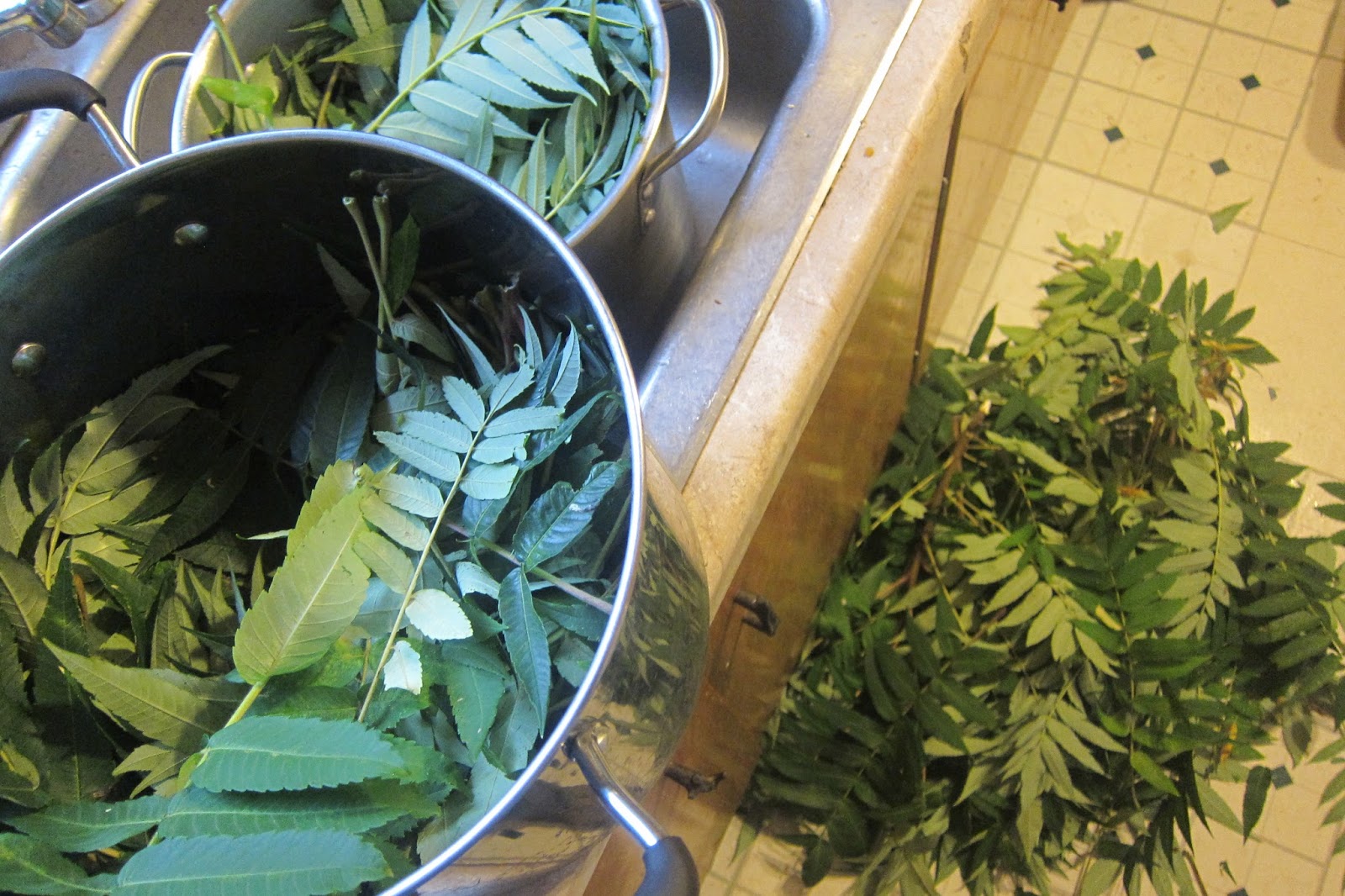
 Processing sumac leaves to make a tannin mordant.

Two good sources for tannin mordants are sumac and rhubarb leaves. As rhubarb is easily available in spring, and sumac easy to find in summer and fall these two make a good three season source of natural tannin mordant. With both sumac and rhubarb the leaves are used, not the wood; for each pound of dry yarn use four pounds of greens. Put leaves in a big pot, cover with water, bring to a boil, and boil for an hour. After an hour remove the greens, add the cellulose yarn and let sit for another hour, or two. Another source for tannins would be black tea, but as that is highly concentrated it would also act as a dye and darken the yarn significantly. Sumac does too, but not as significant and therefore does not interfere with the dyeing process as much, making it a better tannin mordant for brighter colors (and it's free).

A good metal mordant is alum, or aluminum sulfate, which is fairly inexpensive and sold over the internet at stores specializing in dyes. Use 10% for wool or up to 20 % for fine yarn like silk, cotton or linen, of the dry weight of the yarn. Add enough water to submerge the yarn, bring to a boil, turn off, add the damp yarn and let steep for an hour, or so. Do not boil fibers, especially wool roving and tips, as the roiling bubble action of boiling can naturally felt it!

Mordanting the fibers in sumac ‘tea’ overnight.

Mordant the evening before and let the yarn sit in the mordant overnight - that way the yarn is cooled down enough it can easily be squeezed or wrung dry for the next step, the dye bath. Keep in mind that each mordant results in slightly different color dyes, so choose accordingly. For instance chromium really brightens colors (but is poisonous), alum gives clear colors, tin brightens colors and can also be used as an afterbath (adding it to the dye late to darken), copper gives the best greens and iron darkens, and is often used as an afterbath. Both copper and iron can be made at home: copper can be added by dyeing in a copper pot, and an iron solution can easily be made by adding vinegar to iron scraps (like nails and pieces of cheap fencing) in a glass jar - but be careful not to screw down the lid as the exothermic reaction might respond unexpectantly!

Harvesting stinging nettles is quite a prickly business!

Using plant materials it is not all that difficult to dye yellows; pale yellow, lime yellow, greenish yellow, brownish yellow - most plants give some sort of yellow dye. Like ragweed dyes a greenish yellow, birch & poplar dyes yellow, any of the rosacea leaves dye yellow, peach & apple leaves dye yellow and bindweed dyes a light green yellow. It's the other colors that are harder to find. Onion skins can dye a bright orange and reportedly, bindweed roots dye a slight pink, as do rhubarb roots (but I'm not digging up my patch!). Willow leaves and bark dye a cinnamon brown, black walnut a deep brown at first draw and a cinnamon brown at the second. We also tried some odd ones like daffodil heads (yellow) and tageta flowers (also yellow) and honestly, if there is any indication of dye (it stains your fingers while weeding) get a bunch, boil it down, and see what happens!

Harvesting goldenrod flowers to make a bright yellow dye.

Except for a few dyestuffs, like goldenrod, most dye baths benefit from prolonged exposure. A good rule of thumb is to make your bath in the afternoon, add the yarn, put the colander with greens on top of it (keeps the yarn submerged and keeps steeping more dye) and let it sit overnight. You'll benefit from the cooler evening temperatures to cool down your kitchen again and as an added bonus the yarn is nicely cooled down by the next day to easily be rinsed in cold water without starting a felting reaction. Let it dry, or set, completely - out of the sun - before washing with soap.

Goldenrod dye with unmordanted wool yarn (top L) and alum mordanted wool (top R).

In the case of goldenrod, the flowers give the bright yellow color and are a potent dye. The longer it sits, though, the deeper the color gets and at some point the green stems and small leaves, which dye brown, will add, making it even darker. So for a bright yellow 15 minutes tends to be the optimum time. Similar with onion peels; sitting overnight can darken the orange towards brown. Black walnut is also a powerful dye and needs no mordanting at all for wool fibers, making it a good beginner’s dye. It also has antifungal properties and was used for wool underclothing throughout history to help prevent skin conditions!

Onion skin dye with alum mordanted wool fiber and unmordanted wool yarn.

For my first project we used well known dye plants like black walnut leaves, goldenrod flowers, stinging nettle and onion peels. We could have weighed the greens, but as our limitation was space in the pots, not the amount of greens, we picked as much as we could fit into each stockpot. As I could fit three stockpots on my stovetop we made three dye baths at the same time, in a similar fashion as the mordant solution: cover the greens with water, bring to a boil and boil for an hour, or so. Remove the greens, turn off the heat, add the yarn - and see the color change...

We dyed plant fibers and protein fibers and got wildly different results - both between the two types of fibers and from what we expected and what actually happened. Unless every variable, including temperature, pH & weights, are carefully controlled, natural dyeing is quite the spontaneous undertaking! For instance; a linen dress I was hoping to dye a deep brown with black walnut turned into a beautiful yellow copper instead - linen really does not take dye very well. A cotton dress I was hoping to dye yellow with logwood turned blue instead! The wool was mordanted in an acidic environment (an alkaline can damage wool fibers) but not rinsed real well, acidifying the dye to a pretty yellow brown. But when we made a new batch and added the cotton dress it was naturally alkaline and dyed a deep blue!

LTR: undyed, goldenrod, nettle, onion, onion (longer), iron – all unmordanted wool.

We sure saw chemistry in action: what a difference the nature of fibers makes, how some dyes react to changes in the pH but others not at all, the color difference a bit of metal mordant makes, how some strike enthusiastically quick but others need soaking overnight… to get a taste of all the intricate variables possible while still being such a surprisingly easy and rather satisfying project... I totally see how natural dyeing quickly can become quite the passion!


Published in the Aethelmearc Gazette, October 29, 2016
https://aethelmearcgazette.com/2016/10/29/backyard-dyeing-fun/