Thursday, May 11, 2017

Dictionaries as a source of historic information.

Dictionaries are not only to look up descriptions of words: they can also give historical background and detail otherwise unknown. For instance, the Oxford English Dictionary (OED, http://www.oed.com/) is a descriptive dictionary of the English language and the historical development of the English language, providing a comprehensive resource to researchers, as well as describing usage in its many variations throughout the world. Unfortunately the OED is only accessible by membership (check your local library or College computer banks).

Listed below are a couple of alternatives, in the English language but also the Dutch & German, specifically used for medieval terms and their historic significance.

What would one need this for?
For instance, the honeyed ale or malted mead braggot, I would like to know more... not only what it is, what's its history?

Braget, Braggat, Bragot: A sort of beverage formerly esteemed in Wales and the West of England.
"By me that knows not neck-beer from a pheasant. Nor cannot relish braggat from ambrosia" B. and Fl., Little Thief, act 1.
To make Bragotte. Take to x galons of ale, iij potell of fyle worte, and iij quartis of hony, and put therto canell at iiij, peper schort or long, at iiij., galingale, at j., and clowys, at j., and gingiver at ij. MS. 14th century.

And suddenly one finds a very early recipe for Braggot in the English language!

Don't discount the German and Dutch dictionaries, the history of England is intertwined with Dutch and German culture, and often within recipes, especially with the invention of printing, it was the German (Allerley Matkel) and Dutch (t bouck va wondre) manuscripts which were plundered; translated and republished into the English language (the Alexis, a Profitable booke, etc.)!

And, as always, google.translate is your friend :)

Dictionary of Obsolete and Provincial English by Thomas Wright,
1886

Historische Woordenboeken op Internet:

Mittelniederdeutsches Wörterbuch by Schiller & Lubben, Bremen 1876 (several volumes looks like).

Sunday, May 7, 2017

Markham's Of the office of the Brew-house, and the Bake-house, and the necessary things belonging to the same.

From Gervase Markham's The English House-wife comes this chapter on the office of the Brew-house, as the proper English Housewide should be knowledgeable in the provision of Good Drinke!

When our English Housewife knows how to preserve health by wholsome Physick, to nourish by good meat, and to cloth the body with warm Garments, she must not then by any means be ignorant in the provision of Bread and Drink; she must know both the proportions and compositions of the same. And for as much as Drink is in every house more generally spent than Bread, being indeed (but how well I know not) made the very substance of all Entertainment; I will first begin with it, and therefore you shall know that generally our Kingdom hath but two kinds of Drinks, that is to say, Beer and Ale, but particularly four, as Beer, Ale, Perry and Cider; and to these we may added two more, Mede, and Metheglin, two compound Drinks of Honey and Herbs, which in the places where they are made, as in Wales, and the Marches, are reckoned far exceeding wholsom and Cordial.
To speak then of Beer, although there be divers kinds of tasts and strength thereof, according to the allowance of Malt, Hops, and Age given unto the same, yet indeed there can be truly said to be but two kinds thereof, namely Ordinary Beer, and March Beer, all other Beers being derived from them.
Touching ordinary Beer, which is that, wherewith either Nobleman, Gentleman, Yeoman, or Husbandman, shall maintain his family the whole year, it is meet first that our English House-wife respect the proportion or allowance of Malt due to the same, which amongst the best Husbands is thought more convenient that can be allowed, and having Age and good Cask to lye in, it will be strong enough for any good mans drinking.

Now for the brewing of Ordinary Beer, your Malt being well ground, and put in your Mash-fat, and your Liquor of your Lead ready to boyl, you shall then by little and little with Scoops or Pails put the boyling Liquor to the Malt, and then stir it even to the bottom exceeding well together, which is called the Mashing of the Malt, then the Liquor swimming in the Top, cover all over with more Malt, and so let it stand an hour and more in the Mas fat during which space you may if you please heat more Liquor in your Lead for your second or small Drink; this done, pluck up your mashing Stroam, and let the first Liquor run gently from the Malt, either in a clean Trough, or other vessels, prepared for the purpose, and then stopping the Mash-fat again, put the second Liquor to the Malt, and stir it well together, then your Lead being emptied, put your third Liquor or Wort therein, and then to every quarter of Malt put a pound and a half of the best Hops you can get, and boyl them an hour together, till taking up a Dish-ful thereof, you see the Hops shrink into the bottom of the Dish, this done, put the Wort through a straight Sieve, which may drain the Hops from it into your Cooler, which standing over the Guile-fat, you shall in the bottom thereof set a great Bowl with your Barm, and some of the first Word (before the Hops come into it mixt together) that it may rise therein, and then let your Wort drop or run gently into the Dish with the Barm with stands in the Guile-fat, and this you shall do the first day of your brewing, letting your Cooler drop all the night following, and some part of the next morning, and as it drops if you find that a black skum or mother riseth upon the Barm, you shall with your hand take it off, and cast it away, then nothing being left in the Cooler, and the Beer well risen, with your hand stir it about, and so let it stand an hour after, and then beating it and the Barme exceeding well together, run it up into the Hogsheads, being clean wash'd and scalded, and so let it purge, and herein you shall observe not to tun your vessels too full, for fear thereby it purge too much of the Barme away.

When it hath purged a day and a night, you shall close up the Bung-holes with Clay, and only for a day or two after, keep a Vent-hole in it, and after close it up as fast as may be. Now for your second or small drink which are left upon the Grains you shall suffer it there to stay but an hour, or a little better, and then drain it all off also, which done, put it into the Lead with the former Hops, and boyl the other also, then clear it up from the Hops and cover it very close, till your first Beer be Tunned, and then, as before,put it also to Barm, and so Tun it up also in Smaller vessels, and of this second Beer you shall not draw above one Hogshead to three of the better. Now there be diverse other wayes and observations for the brewing of ordinary Beer, but none so good, so easie,so ready and quickly performed, as this before is shewed, neither will any Beer left longer, or ripen sooner, for it may be drunk at a fortnights-age, and will last as long and lively.

Now for the brewing of the best March-Beer, you shall allow to a Hogshead thereof, a quarter of the best Malt well ground, then you shall take a peck of Pease, half a peck of Wheat, and half a peck of Oats, and grind them all very well together, and then mix them with your Malt, which done, you shall in all points brew this Beer, as you did the former ordinary Beer, only you shall allow a pound and a half of Hops to this Hogshead: and whereas before you drew but two sorts of Beer, so now you shall draw three, that is a Hogshead of the best, and a Hogshead of the second, and half a Hogshead of small Beer, without any augmentation of Hops or Malt.

This March-beer would be brewed in the months of March or April, and should (if it have right) have a whole year to ripen in : it will last two, three, or four years, if it lye cool, and endure the drawing to the last drop, though with never so much leisure.

Now for the Brewing of strong Ale, because it is Drink of no such long lasting as Beer is, therefore you shall brew lesse quantity at a time thereof, as two Bushels of Northern measure, (which is four bushels, or half a quarter in the South) at a Brewing, and not above, which will make fourteen Gallons of the best Ale. Now for the mashing and the ordering in the Mash-fat, it will not differ any thing from that of Beer: as for Hops, although some use not to put in any, yet the best Brewers thereof will allow to fourteen Gallons of Ale a good Espen full of Hops, and no more, yet before you put in your Hops, as soon as you take it from the Grains, you shall put it into a vessel, and change it, or blink it, in this manner: Put into the Wort a Handful of Oak-boughs, and a Pewter-dish, and let them lye therein till the Wort look a little paler than it did at first, and then presently take out the Dish and the Leaves, and then boyl it a full Hour with the Hops, as aforesaid, and then cleanse it, and set it in vessels to cool; when it is milk-warm, having set your Barm to rise with some sweet Wort, then put all into the Guile-fat, and as soon as it riseth, with a Dish and Bowl beat it in, and so keep it with continual beating a day and a night at least, and after tun it. From this Ale you may also draw half so much very good middle Ale, and a third part very good small Ale.

Touching the brewing of Bottle-Ale, it differeth nothing at all from brewing of strong Ale, onely it must be drawn in a larger proportion, as at least twenty Gallons of half a quarter, and when it comes to be changed, you shall blink it (as was before shewed) more by much than was the strong Ale, for it must be pretty and sharp, which giveth the life and quickness to the Ale: and when you tun it, you shall put it into round Bottles with narrow mouths, and then stopping them close with Cork, set them in a cold Cellar up to  the waiste in Sand, and be sure that the Corks be fast tied in with strong packthread, for fear or rising out, or taking vent, which is the utter spoyl of the Ale.

Now for the small drink arising from this Bottle-Ale, or any other Beer or Ale whatsoever, if you keep it after it is blink'd and boyled in a close vessel, and then put it to Barm every morning as you have occasion to use it, the Drink will drink a great deal fresher, and be much more lively in tast.

Gervase Markham, the English Hus-wife, 1615
https://digital.library.lse.ac.uk/objects/lse:heh898zor/read/single#page/1/mode/2up

Friday, May 5, 2017

Of the manner of drinking amongst the Northern People.

"It will not displease curious Readers, to hear how the epistome is of drinking amongst the Northern People. First, that they hold it Religion to drink the healths of Kings and Princes, standing, in reverence of them ; and here they will as it were sweat in the contention, who shall at one or two, or more draughts drink off a huge bowl. Wherefore they seem to sit at Table as if they had Crowns on their heads, and to drink in a certain kind of a vessel : which, may be, may cause men that know it not, to admire it. But that were more admirable to see the servants to go in a long train in troops, as Pastours of Harts with horns, that they may drink up those Cups full of beer to the Ghests. And not-content with these Ceremonies, they will strive to shew their Sobriety, by setting such a high Cup full of Beer upon their naked heads , and dance and turn round with it : In like manner they deliver other Cups which they bring in both hands to the Ghests to drink off at equall draughts, which are full of Wine, Ale, Mede, Metheglin, or new Wine..."


From Olaus Magnus A Compendious History of the Goths & Vandals and Other Northern Nations, 1658 (Latin edition 1555).

Werewolves do like their mead or beer...


"In the night, at a certain place, that they are resolved upon amongst themselves, there is gathered together such a huge multitude of Wolves changed from men that dwell in divers places, which afterwards the sane night doth so rage with wonderfull fiercenesse, both against mankind and other creatures, that are not fierce by nature, that the Inhabitants of that Country suffer more hurt from them, than ever they do from true naturall Wolves. For as it is proved, they set upon the houCes of men that are in the Woods with wonderfull fiercenesse, and labour to break down the doors, whereby they may destroy both men and other creatures that remain there. They go into Beer-Cellars, and there they drink out some Tuns of Beer or Mede, and they heap all the empty vessels one upon another in the midst of the Cellar, and so leave them : wherein they differ from natural and true Wolves..."

From Olaus Magnus "Of the Fierceness of Men who by Charms are turned into Wolves", A Compendious History of the Goths & Vandals and Other Northern Nations, 1658

Tuesday, April 11, 2017

About the Aquamanile.

As part of my research into medieval soap I stumbled onto the ritual of hand washing at the table, and the use of whimsical pitchers to pour the water to do so. As black soap is not all that visually exciting, a beautiful medieval aquamanile reproduction would be the perfect eye candy for my A&S displays. Except all the ones I found available were in Europe... and as shipping is worrisome, and prohibitively expensive, I took the plunge to build my own.

An aquamanile, from the Latin words for water (aqua) and hand (manus), is an animal- or human-shaped vessel used for washing the hands. Medieval European examples date from the 12th C through the 15th C and, apart from curious shapes, have two water openings, one for pouring and one for filling, and a handle. According to the St. Thomas Guild website, the name aquamanile for the vessel was not invented until the 19th C.: the medieval name for the aquamanile was lavoratorium, and the bowl receiving the water was the manilia. But as most resources including the Metropolitan Museum of Art (MET) designate these vessels as aquamanile, I will do the same.

From Francis Seager’s School of Virtue (1557) comes this poem to direct children to bring their parents water to wash when clearing the table after a meal:

Then on the table                  attend with all diligénce,
It for to void,                      when done have thy parénts.
Each side of the cloth            do thou turn in ;
Folding it up,                      at the higher end begin.
A clean towel then                 on the table spread,
The towel wanting,                 the cloth take instead.
The basin and ewer                to the table then bring,
In place convenient,                 their pleasure abiding.
When thou shalt see              them ready to wash,
The ewer take up,                 and be not too rash
In pouring out water               more than will suffice.
         Chatto, 1908
           
The hundreds of surviving examples show the popularity of aquamanilia during the Middle Ages. The aquamanile was a sculptural vessel, often cast in copper alloy using the lost-wax method, and made in many forms like lions, griffins, horses, unicorns, stags, dragons and even men. Aquamanilia were important items for religious hand washing rituals, but also became a luxurious show piece at a Lords’ table. For the upper class clientele pottery aquamanilia were available, evident by their mention in two inventories of medieval citizens in the city of Deventer, the Netherlands (St. Thomas). Regular sets of ewers and bowls are found in many inventories, but the aquamanile surely is the pinnacle of medieval hand washing equipment.


The aquamanile from Castle Hoensbroek which was found in the castle moat. The figure probably represents a ram. The aquamanile is dated to the mid 14th century and decorated with green-tin glaze. 

Animal shaped were not a new idea. Late Roman, early Byzantine, and Islamic cultures had a vibrant tradition of hollow-cast vessels in animal form. Although late Roman and early Byzantine examples were made to contain oil rather than water, they could be seen as precursors of medieval aquamanila in how they were made, as well as in the use of animal forms. Islamic aquamanilia could have been among the luxury items brought to the West through diplomatic gift exchange, trading routes, or even as booty from the Crusades. Western European metalworkers, proficient in the casting of solid objects, relearned a set of skills that had been lost in the West since antiquity when adapting the designs of Islamic hollow-cast vessels to create aquamanilia. (MET)


Example of a copper alloy Dragon aquamanile from The Metropolitan Museum, one of the largest and most important collections of aquamanilia in the world. This dragon aquamanile is supported by its legs in front and on the tips of its wings behind, and has a tail that curls up into a handle. It was filled through an opening in the tail, now missing its hinged cover. Water was poured out through the spout formed by the hooded or cowled figure held between the dragon's teeth. In addition to its visual power, this aquamanile is distinguished by fine casting, visible in the carefully chased dragon's scales and other surface details.

As is indicated by its name, aquamanilia were used by the general populace to wash the hands. Initially aquamanilia were used in both Christian and Jewish religious ritual, but by the 12th C the vessels start appearing outside the church, and at the dinner table. The aquamanile would be used in combination with a wide, shallow bowl, usually made of metal, and sometimes of pottery, and with towels made of linen, plain white or damask, which could be striped. (Heise 2007)

“Sometimes guest were formally conducted to an adjoining lavatory accompanied by the music of a minstrel, but ordinarily they remained in the hall and received from the ewer the warm water; often perfumed with rose-leaves, thyme lavender, sage, chamomile, marjoram or orange peel, one or all. The water and the towels were, of course, presented in the order of social standing of the guest, and it was esteemed a signal honor thus to serve a king or a great noble. In accord with the dignity of the ceremony the water jug and the basin in great houses were often of gold or silver curiously wrought and enameled.”
Edward Mead in his The English Medieval Feast, 1967. (Heise 2007)

There are several period scented water recipes available to use with the aquamanile. For instance Sir Hugh Plat’s Delightes for Ladies lists “An Excellent Washing Water Very Cheap” which is distilled and “Diverse sorts of sweet handwaters made suddenly or extempore with extracted oils of spices.” which uses extracted essential oils. Another way to make scented water would be by infusion as suggested by Le Menagier de Paris, a 14th century cook- and housekeeping book, where a description is given for water used to wash the hands:

Pour faire eaue a laver mains sur table, mectez bouillir de la sauge, puis coulez l'eaue et faictes reffroidier jusques a plus que tiede. Ou vous mectez comme dessus comomille et marjolaine, ou vous mectez du romarin, et cuire avec l'escorche d'orenge. Et aussi feuilles de lorier y sont bonnes.”

“To make water for washing hands at table: Boil sage, then strain the water and cool it until it is a little more than lukewarm. Or use chamomile, marjoram or rosemary boiled with orange peel. Bay leaves are also good.” (Greco 2009)

The Scented Waters I made for use in the A&S Competition:


Water scented with sage: home grown and dried sage leaves, boiled with rain water. Sage helps in keeping skin healthy, including skin inflammations like eczema.

Water scented with Rosemary and Orange: personally harvested rosemary (from the Carolina’s, where it is grown as an ornamental) and dried orange peels, boiled with rain water. The acids in orange peels act as a natural degreaser.
Rosemary (family of sage) helps in keeping skin healthy and has an antibacterial effect.

My Project.

Years ago I played in a university ceramics studio, but hand building sculptures was never really my thing. For the past few years I’ve stored a small kick wheel but had no kiln. After a friend of mine offered to bisque and glaze our projects my kid and I played around for a winter or two, with the idea to reclaim clay from our property and throw small Viking type cups & bowls. Trying to build an aquamanile is lightyears beyond that, and not a minor decision, so in the hope one would work out, I started work on three different shapes.

Aquamanile in the shape of a ram from Castle Hoensbroek.
I wanted to do this one as it was found in the Netherlands. But for the life of me I could not throw a pitcher to then narrow the waist without collapsing the clay, so this design bit the dust in the throwing stage. The bump on the rear of this ram seems to indicate it was thrown as one shape, with that being the plugged neck.


Aquamanile in the shape of a stag.
Found in Rye, UK and dated to the 14th C. It is 24 cm high and 35.5 cm long and made from red earthenware with lead glaze. The body is tubular, the antlers lie back to form the handle, and the hind legs are missing. The body seems to be made from a large tubular vessel with a smaller vase chest and a bud vase head.


Aquamanile in the shape of a ram.
This aquamanile is assumed to be from Scarborough, England and made between 1250 to 1350 CE. It is made from earthenware with green glaze and measures 23.9 cm by 29.2 cm by 13.3 cm. It seems to be made from two larger jars, with a small bud vase as the head and a separately thrown neck as the water intake. It likely is missing its horns, from the absence of glaze on the sides of the head.


Short Glossary:

Bisque: The first stage of heating clay. Bisque dry means the object is ready to be bisqued. A clay object first is bisqued heated so it is hard, then glaze is added and it is heated again to melt the glaze. So each glazed piece is heated twice, once to harden, and once to glaze.
Leather Hard: letting clay dry for a while (often overnight) to partially dry out to a stage where it will be sturdy enough to withstand adding things onto it, like handles, legs etc.
Kiln: the oven clay is fired or heated in (I borrow the use of a friend’s kiln).
Slip: very watered down clay which can be used as glue.
Score, scoring: drawing lines into the clay with a sharp object to increase the surface of where two pieces of clay will be attached. Slip is added to cover the inscribed lines to soften the clay for maximal stickiness and thus adherence.


Wheel: the apparatus clay is thrown on. A heavy weight is kicked around an axle with a small tray at the top, the heavy weight keeps the small tray turning with just enough time between kicks to throw shapes out of clay. I use a mechanical kick wheel which looks like and works very similar to the kick wheels used in medieval times.


Bibliography

Amman, Jost (1568) Panoplia omnium lliberalium mechanicarum (Book of Trades); Der
Haffner (The Potter), one of 133 woodcut book illustrations. Frankfurt: Sigmund Feierabend. The British Museum.
http://www.britishmuseum.org/research/collection_online/collection_object_details/collection_image_gallery.aspx?assetId=1127437001&objectId=3106145&partId=1

Chatto, Edith Rickert Francis Seager’s School of Virtue (1557) part of the Babees Book:
Medieval Manners for the Young: Done into Modern English from Dr. Furnivall S. Texts, p.151 London / New York: Duffield & Co., 1908

Greco, Gina L. & Rose, Chrisine M. (ed.) The Good Wife’s Guide (Le Ménagier de Paris, 1393).
Ithaca: Cornell University Press, 2009.

Heise, Jennifer (2007) Hygiene of the Middle Ages and Rennaissance, Volume One: Personal
Grooming The Compleat Anachronist #136

Metropolitan Museum of Art (MET): Medieval Aquamanilia
http://www.metmuseum.org/toah/hd/aqua/hd_aqua.htm

Metropolitan Museum of Art (MET): Dragon aquamanile
http://www.metmuseum.org/art/collection/search/471287

Metropolitan Museum of Art (MET): Stag aquamanile
http://collections.vam.ac.uk/item/O9254/aquamanile-unknown/

Plat, Sir Hugh (1609) Delightes for Ladies. London: printed by Peter Short.
http://eebo.chadwyck.com/home

St. Thomas Guild: Medieval Table Manners.
http://thomasguild.blogspot.com/2013_10_01_archive.html

Virginia & albert Museum (VA): Ram aquamanile
http://www.metmuseum.org/art/collection/search/477815

Waterdene, Chrestiennede: Facebook post Stag Aquamanile.
https://www.facebook.com/ChrestiennedeWaterdene/posts/950022085106635?theater


Possible Way of Assembly of the Ram from the MET.


Technical Data on the Extant Piece:
Date: ca. 1250–1350
Geography: Made in Scarborough, England
Culture: British
Medium: Earthenware, green glaze
Dimensions: Overall: 9 7/16 x 11 1/2 x 5 1/4 in. (23.9 x 29.2 x 13.3 cm)
Classification: Ceramics
Credit Line: The Cloisters Collection, 2007 at the Metropolitan Museum of Art, NYC.
Accession Number: 2007.142
This pottery aquamanile is a rare survivor and preserves some of its original green glaze.


Technical Data on my piece:
Date: the 27th of July, 2016 (started June 30th)
Place of Origin: Aethelmearc (NY, Ithaca basement)
Medium: Red earthenware (WC614); blue (outside) & white (inside & horns) glaze
Dimensions: 7.5 x 7.5 x 3 in.


Throw two pieces on a wheel; for the ram this would be a pitcher shape and a cylinder. Wrap loosely in plastic (damp cloth) and let dry to leather hard overnight.


Line up the cylinder (part 1) with the belly (part 2)of the pitcher, inscribe the edge and cut out the inside piece.Score and cover the edges with slip (diluted clay which functions as glue), press well together, and sculpt into one piece.

Carefully roll legs, measure and attach to body suing the score and slip glue method. I added a small roll of clay at the base of the legs to widen the base as is seen in the original.


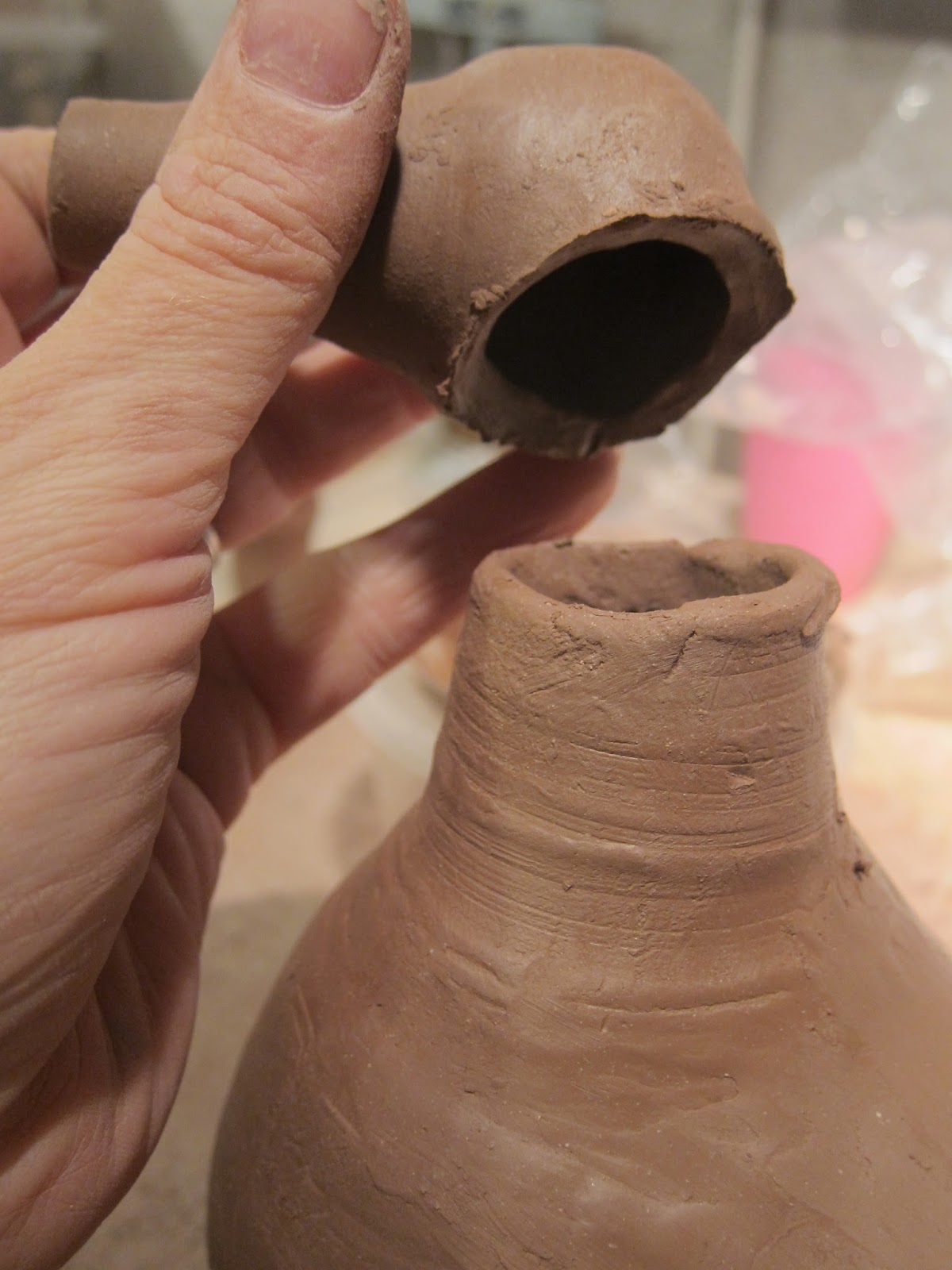
Throw a tiny vase (part 3, a bud vase) of the shape of the head. Measure and mark the neck of the pitcher onto the belly of the bud vase, mark and cut away. Use the score and glue method to clay them together at the correct angle for the head. The neck of the bud vase will become the water spout or mouth of the aquamanile.


Then throw only a neck (part 4), detach of clay clump on wheel, measure, cut out, and score & glue on back of ram in the shoulder area.


Then hand-pull a handle (I do not have an extruder) and attach the handle from butt to filling spout. I used bits of dry clay in between to shape it into a nice curve until it dried stiff. I also added decorative grooves all around the body.


And as a finishing touch: add horns.

The original lost it’s horns, but from the lack of glaze it’s clear horns were there but broken off at some point in time.

Now it is time to dry. Wrap the thin part like the head and spout better than the thicker parts like the body so it dries pretty evenly.
  

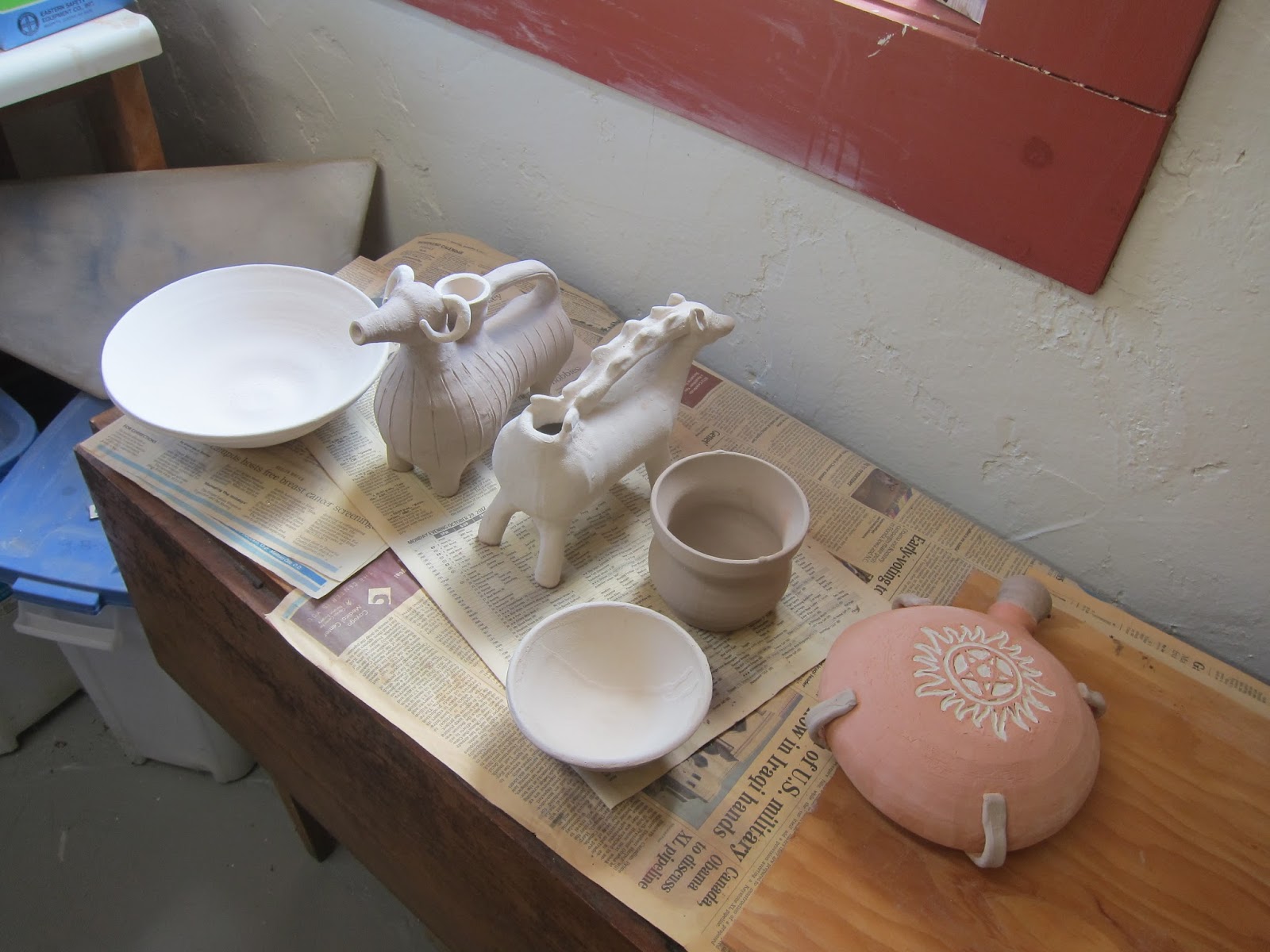
When carefully dried, the clay ram is bisque fired. Clay is fired twice, once to harden and another time at a higher temperature to melt the glaze. After bisqueing the ram was dipped in glaze (looks like watery mud). As I have to use the same glazes as the owner of the kiln (so we can share firing without having chemical or temperature issues) and she does not use green, I could not glaze the ram green like the original.


The extant piece as photographed at the MET.


I went to see the Medieval collection at the Cloisters of the Metropolitan Museum this Christmas and to my happy surprise found this aquamanile on display. It was very rewarding to see it life after having trying to emulate it shapes. As I only had one view to work from, it was wonderful to photograph it from all sides and was happy to find my interpretation is pretty close. Except for size, it’s huge at about twice as big!

. : The finished piece : .


Bibliography
 

Heise, Jennifer (2007) Hygiene of the Middle Ages and Rennaissance, Volume One: Personal
Grooming The Compleat Anachronist #136

Metropolitan Museum of Art (MET): Medieval Aquamanilia
http://www.metmuseum.org/toah/hd/aqua/hd_aqua.htm
  
Metropolitan Museum of Art (MET): Ram aquamanile
http://www.metmuseum.org/art/collection/search/477815


St. Thomas Guild: Medieval Table Manners.
http://thomasguild.blogspot.com/2013_10_01_archive.html


Possible Way of Assembly of the Stag Aquamanile from the V&A..


Technical Data on the Extant Piece:
Place of origin: England (made) Rye (made)
Date: 1300-1399 (made)
Artist/Maker: Unknown (maker)
Materials and Techniques: Red earthenware and a yellow glaze tinged with green
Credit Line: Given by Lady Lister
Museum number: C.343-1919
Gallery location: Ceramics, Room 138, The Harry and Carol Djanogly Gallery, case A, shelf 5 of the Virginia and Albert Museum in London, UK.
Descriptive line: Red earthenware covered with yellowish lead glaze and green glaze. English (Rye), 14th century. Found near Maresfield, East Sussex according to Mr. Alexander.
Physical description: Aquamanile of red earthenware in the form of a stag covered with a yellow glaze tinged with green. It has a tubular body and the antlers lie back to form the handle. The hind legs are missing.


Technical Data on my piece:
Date: the 27th of July, 2016 (Started July 1st)
Place of Origin: Aethelmearc (NY, Ithaca basement)
Medium: Red earthenware (WC614); iron oxide slip on the body, white glaze
Dimensions: 8 x 6 x 3 in.


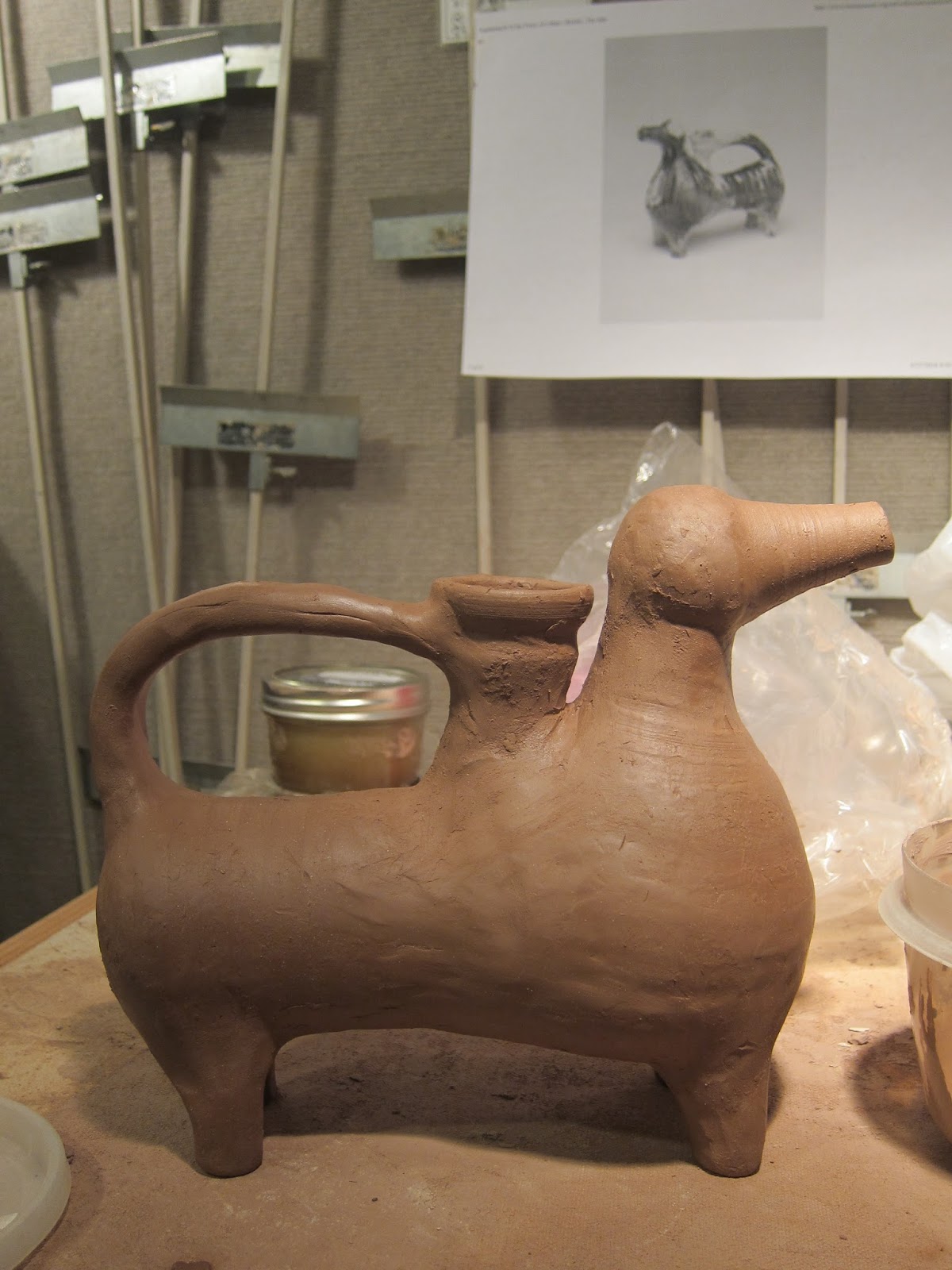
Throw two pieces on a wheel; a larger tubular vase and a smaller bud vase. Wrap loosely in plastic and let dry to leather hard overnight.


Line up the bud vase with the edge of the main body, and inscribe and then cut out the inside piece.


Score and cover with slip (diluted clay that serves as glue), press well together, and sculpt into one piece.

 
Carefully roll legs, measure into similar lengths, and attach to main body with the score and glue method. I also added a small roll of clay around the base of the leg for extra strength (plus it matches the flared silhouette of the original legs). Make sure not to trap any pockets of air anywhere as those can cause explosions when fired.


When the legs are attached, wrap loosely in plastic (in medieval times it would be wrapped in damp cloth) and rest overnight. The original only has the front legs, the back ones probably broke off from the weight of shifting dirt while being buried.

 
When the legs are nice and firm and support the body well, start working on the head. I did not throw the head as it is relatively small, instead I made a pinch pot in the right shape. Remove the part that is at the neck opening, and use the score and glue method to secure everything together.


I rolled two antlers of similar size and the right length and sculpted them to the back of the head. I used a piece of semi dry clay to help keep the wet clay from sagging. I used the score & glue method to stick the two antlers together, it would also be plausible to make one flat antler and carve it into two separate staves. I then cut a hole in the rear and worked the ends of the antlers around it to disguise the edge.
Then I glued on and sculpted the small horns on the antlers, and finished the rear water intake. From the museum photograph it is hard to see for sure where the water intake should be, and after careful consideration of the design I decided this would be the most likely place. 


As shown on the extant piece, I then added ears, chest flap, a mouth and eyes with eyebrows.


The Stag was bisqued. To emulate the orange tint glaze I used iron oxide under a white glaze for the body, with no iron oxide for the antlers.


Even though white glaze does not match the original clear glaze as much as I would have liked, the finished Stag Aquamanile emulates the look and function of the original nicely, and is a pleasure to look at and use.
 
 My interpretation bisqued and glazed. I used iron oxide under a white glaze.   

   The original, as photographed by the Victoria & Albert Museum, London.


. : The Finished Piece : .


Bibliography
  

Heise, Jennifer (2007) Hygiene of the Middle Ages and Rennaissance, Volume One: Personal
Grooming The Compleat Anachronist #136

Metropolitan Museum of Art (MET): Medieval Aquamanilia
http://www.metmuseum.org/toah/hd/aqua/hd_aqua.htm
St. Thomas Guild: Medieval Table Manners.
http://thomasguild.blogspot.com/2013_10_01_archive.html

Virginia & albert Museum (VA): Stag aquamanile
http://collections.vam.ac.uk/item/O9254/aquamanile-unknown/