Tuesday, April 11, 2017

About the Aquamanile.

As part of my research into medieval soap I stumbled onto the ritual of hand washing at the table, and the use of whimsical pitchers to pour the water to do so. As black soap is not all that visually exciting, a beautiful medieval aquamanile reproduction would be the perfect eye candy for my A&S displays. Except all the ones I found available were in Europe... and as shipping is worrisome, and prohibitively expensive, I took the plunge to build my own.

An aquamanile, from the Latin words for water (aqua) and hand (manus), is an animal- or human-shaped vessel used for washing the hands. Medieval European examples date from the 12th C through the 15th C and, apart from curious shapes, have two water openings, one for pouring and one for filling, and a handle. According to the St. Thomas Guild website, the name aquamanile for the vessel was not invented until the 19th C.: the medieval name for the aquamanile was lavoratorium, and the bowl receiving the water was the manilia. But as most resources including the Metropolitan Museum of Art (MET) designate these vessels as aquamanile, I will do the same.

From Francis Seager’s School of Virtue (1557) comes this poem to direct children to bring their parents water to wash when clearing the table after a meal:

Then on the table                  attend with all diligénce,
It for to void,                      when done have thy parénts.
Each side of the cloth            do thou turn in ;
Folding it up,                      at the higher end begin.
A clean towel then                 on the table spread,
The towel wanting,                 the cloth take instead.
The basin and ewer                to the table then bring,
In place convenient,                 their pleasure abiding.
When thou shalt see              them ready to wash,
The ewer take up,                 and be not too rash
In pouring out water               more than will suffice.
         Chatto, 1908
           
The hundreds of surviving examples show the popularity of aquamanilia during the Middle Ages. The aquamanile was a sculptural vessel, often cast in copper alloy using the lost-wax method, and made in many forms like lions, griffins, horses, unicorns, stags, dragons and even men. Aquamanilia were important items for religious hand washing rituals, but also became a luxurious show piece at a Lords’ table. For the upper class clientele pottery aquamanilia were available, evident by their mention in two inventories of medieval citizens in the city of Deventer, the Netherlands (St. Thomas). Regular sets of ewers and bowls are found in many inventories, but the aquamanile surely is the pinnacle of medieval hand washing equipment.


The aquamanile from Castle Hoensbroek which was found in the castle moat. The figure probably represents a ram. The aquamanile is dated to the mid 14th century and decorated with green-tin glaze. 

Animal shaped were not a new idea. Late Roman, early Byzantine, and Islamic cultures had a vibrant tradition of hollow-cast vessels in animal form. Although late Roman and early Byzantine examples were made to contain oil rather than water, they could be seen as precursors of medieval aquamanila in how they were made, as well as in the use of animal forms. Islamic aquamanilia could have been among the luxury items brought to the West through diplomatic gift exchange, trading routes, or even as booty from the Crusades. Western European metalworkers, proficient in the casting of solid objects, relearned a set of skills that had been lost in the West since antiquity when adapting the designs of Islamic hollow-cast vessels to create aquamanilia. (MET)


Example of a copper alloy Dragon aquamanile from The Metropolitan Museum, one of the largest and most important collections of aquamanilia in the world. This dragon aquamanile is supported by its legs in front and on the tips of its wings behind, and has a tail that curls up into a handle. It was filled through an opening in the tail, now missing its hinged cover. Water was poured out through the spout formed by the hooded or cowled figure held between the dragon's teeth. In addition to its visual power, this aquamanile is distinguished by fine casting, visible in the carefully chased dragon's scales and other surface details.

As is indicated by its name, aquamanilia were used by the general populace to wash the hands. Initially aquamanilia were used in both Christian and Jewish religious ritual, but by the 12th C the vessels start appearing outside the church, and at the dinner table. The aquamanile would be used in combination with a wide, shallow bowl, usually made of metal, and sometimes of pottery, and with towels made of linen, plain white or damask, which could be striped. (Heise 2007)

“Sometimes guest were formally conducted to an adjoining lavatory accompanied by the music of a minstrel, but ordinarily they remained in the hall and received from the ewer the warm water; often perfumed with rose-leaves, thyme lavender, sage, chamomile, marjoram or orange peel, one or all. The water and the towels were, of course, presented in the order of social standing of the guest, and it was esteemed a signal honor thus to serve a king or a great noble. In accord with the dignity of the ceremony the water jug and the basin in great houses were often of gold or silver curiously wrought and enameled.”
Edward Mead in his The English Medieval Feast, 1967. (Heise 2007)

There are several period scented water recipes available to use with the aquamanile. For instance Sir Hugh Plat’s Delightes for Ladies lists “An Excellent Washing Water Very Cheap” which is distilled and “Diverse sorts of sweet handwaters made suddenly or extempore with extracted oils of spices.” which uses extracted essential oils. Another way to make scented water would be by infusion as suggested by Le Menagier de Paris, a 14th century cook- and housekeeping book, where a description is given for water used to wash the hands:

Pour faire eaue a laver mains sur table, mectez bouillir de la sauge, puis coulez l'eaue et faictes reffroidier jusques a plus que tiede. Ou vous mectez comme dessus comomille et marjolaine, ou vous mectez du romarin, et cuire avec l'escorche d'orenge. Et aussi feuilles de lorier y sont bonnes.”

“To make water for washing hands at table: Boil sage, then strain the water and cool it until it is a little more than lukewarm. Or use chamomile, marjoram or rosemary boiled with orange peel. Bay leaves are also good.” (Greco 2009)

The Scented Waters I made for use in the A&S Competition:


Water scented with sage: home grown and dried sage leaves, boiled with rain water. Sage helps in keeping skin healthy, including skin inflammations like eczema.

Water scented with Rosemary and Orange: personally harvested rosemary (from the Carolina’s, where it is grown as an ornamental) and dried orange peels, boiled with rain water. The acids in orange peels act as a natural degreaser.
Rosemary (family of sage) helps in keeping skin healthy and has an antibacterial effect.

My Project.

Years ago I played in a university ceramics studio, but hand building sculptures was never really my thing. For the past few years I’ve stored a small kick wheel but had no kiln. After a friend of mine offered to bisque and glaze our projects my kid and I played around for a winter or two, with the idea to reclaim clay from our property and throw small Viking type cups & bowls. Trying to build an aquamanile is lightyears beyond that, and not a minor decision, so in the hope one would work out, I started work on three different shapes.

Aquamanile in the shape of a ram from Castle Hoensbroek.
I wanted to do this one as it was found in the Netherlands. But for the life of me I could not throw a pitcher to then narrow the waist without collapsing the clay, so this design bit the dust in the throwing stage. The bump on the rear of this ram seems to indicate it was thrown as one shape, with that being the plugged neck.


Aquamanile in the shape of a stag.
Found in Rye, UK and dated to the 14th C. It is 24 cm high and 35.5 cm long and made from red earthenware with lead glaze. The body is tubular, the antlers lie back to form the handle, and the hind legs are missing. The body seems to be made from a large tubular vessel with a smaller vase chest and a bud vase head.


Aquamanile in the shape of a ram.
This aquamanile is assumed to be from Scarborough, England and made between 1250 to 1350 CE. It is made from earthenware with green glaze and measures 23.9 cm by 29.2 cm by 13.3 cm. It seems to be made from two larger jars, with a small bud vase as the head and a separately thrown neck as the water intake. It likely is missing its horns, from the absence of glaze on the sides of the head.


Short Glossary:

Bisque: The first stage of heating clay. Bisque dry means the object is ready to be bisqued. A clay object first is bisqued heated so it is hard, then glaze is added and it is heated again to melt the glaze. So each glazed piece is heated twice, once to harden, and once to glaze.
Leather Hard: letting clay dry for a while (often overnight) to partially dry out to a stage where it will be sturdy enough to withstand adding things onto it, like handles, legs etc.
Kiln: the oven clay is fired or heated in (I borrow the use of a friend’s kiln).
Slip: very watered down clay which can be used as glue.
Score, scoring: drawing lines into the clay with a sharp object to increase the surface of where two pieces of clay will be attached. Slip is added to cover the inscribed lines to soften the clay for maximal stickiness and thus adherence.


Wheel: the apparatus clay is thrown on. A heavy weight is kicked around an axle with a small tray at the top, the heavy weight keeps the small tray turning with just enough time between kicks to throw shapes out of clay. I use a mechanical kick wheel which looks like and works very similar to the kick wheels used in medieval times.


Bibliography

Amman, Jost (1568) Panoplia omnium lliberalium mechanicarum (Book of Trades); Der
Haffner (The Potter), one of 133 woodcut book illustrations. Frankfurt: Sigmund Feierabend. The British Museum.
http://www.britishmuseum.org/research/collection_online/collection_object_details/collection_image_gallery.aspx?assetId=1127437001&objectId=3106145&partId=1

Chatto, Edith Rickert Francis Seager’s School of Virtue (1557) part of the Babees Book:
Medieval Manners for the Young: Done into Modern English from Dr. Furnivall S. Texts, p.151 London / New York: Duffield & Co., 1908

Greco, Gina L. & Rose, Chrisine M. (ed.) The Good Wife’s Guide (Le Ménagier de Paris, 1393).
Ithaca: Cornell University Press, 2009.

Heise, Jennifer (2007) Hygiene of the Middle Ages and Rennaissance, Volume One: Personal
Grooming The Compleat Anachronist #136

Metropolitan Museum of Art (MET): Medieval Aquamanilia
http://www.metmuseum.org/toah/hd/aqua/hd_aqua.htm

Metropolitan Museum of Art (MET): Dragon aquamanile
http://www.metmuseum.org/art/collection/search/471287

Metropolitan Museum of Art (MET): Stag aquamanile
http://collections.vam.ac.uk/item/O9254/aquamanile-unknown/

Plat, Sir Hugh (1609) Delightes for Ladies. London: printed by Peter Short.
http://eebo.chadwyck.com/home

St. Thomas Guild: Medieval Table Manners.
http://thomasguild.blogspot.com/2013_10_01_archive.html

Virginia & albert Museum (VA): Ram aquamanile
http://www.metmuseum.org/art/collection/search/477815

Waterdene, Chrestiennede: Facebook post Stag Aquamanile.
https://www.facebook.com/ChrestiennedeWaterdene/posts/950022085106635?theater


Possible Way of Assembly of the Ram from the MET.


Technical Data on the Extant Piece:
Date: ca. 1250–1350
Geography: Made in Scarborough, England
Culture: British
Medium: Earthenware, green glaze
Dimensions: Overall: 9 7/16 x 11 1/2 x 5 1/4 in. (23.9 x 29.2 x 13.3 cm)
Classification: Ceramics
Credit Line: The Cloisters Collection, 2007 at the Metropolitan Museum of Art, NYC.
Accession Number: 2007.142
This pottery aquamanile is a rare survivor and preserves some of its original green glaze.


Technical Data on my piece:
Date: the 27th of July, 2016 (started June 30th)
Place of Origin: Aethelmearc (NY, Ithaca basement)
Medium: Red earthenware (WC614); blue (outside) & white (inside & horns) glaze
Dimensions: 7.5 x 7.5 x 3 in.


Throw two pieces on a wheel; for the ram this would be a pitcher shape and a cylinder. Wrap loosely in plastic (damp cloth) and let dry to leather hard overnight.


Line up the cylinder (part 1) with the belly (part 2)of the pitcher, inscribe the edge and cut out the inside piece.Score and cover the edges with slip (diluted clay which functions as glue), press well together, and sculpt into one piece.

Carefully roll legs, measure and attach to body suing the score and slip glue method. I added a small roll of clay at the base of the legs to widen the base as is seen in the original.


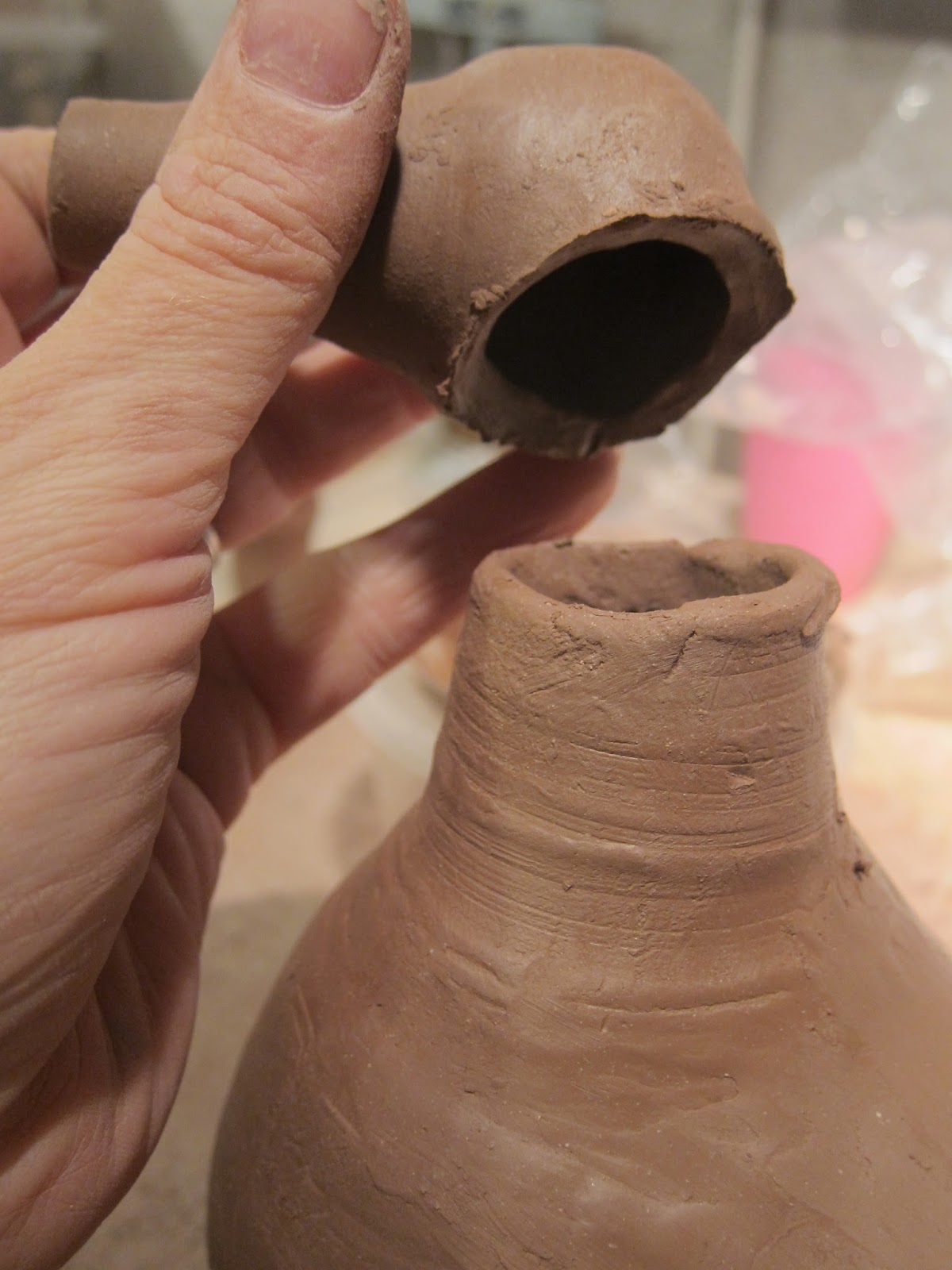
Throw a tiny vase (part 3, a bud vase) of the shape of the head. Measure and mark the neck of the pitcher onto the belly of the bud vase, mark and cut away. Use the score and glue method to clay them together at the correct angle for the head. The neck of the bud vase will become the water spout or mouth of the aquamanile.


Then throw only a neck (part 4), detach of clay clump on wheel, measure, cut out, and score & glue on back of ram in the shoulder area.


Then hand-pull a handle (I do not have an extruder) and attach the handle from butt to filling spout. I used bits of dry clay in between to shape it into a nice curve until it dried stiff. I also added decorative grooves all around the body.


And as a finishing touch: add horns.

The original lost it’s horns, but from the lack of glaze it’s clear horns were there but broken off at some point in time.

Now it is time to dry. Wrap the thin part like the head and spout better than the thicker parts like the body so it dries pretty evenly.
  

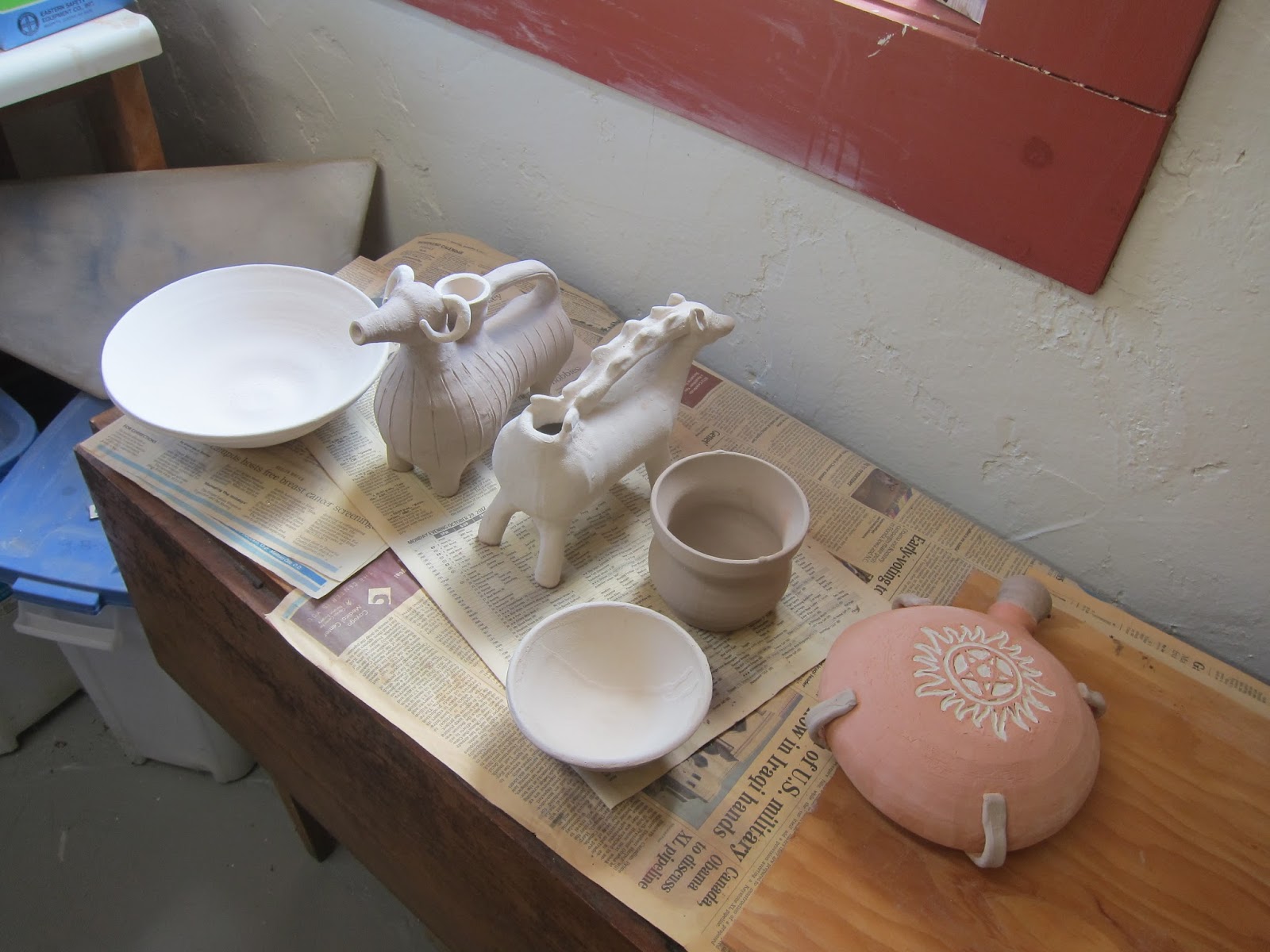
When carefully dried, the clay ram is bisque fired. Clay is fired twice, once to harden and another time at a higher temperature to melt the glaze. After bisqueing the ram was dipped in glaze (looks like watery mud). As I have to use the same glazes as the owner of the kiln (so we can share firing without having chemical or temperature issues) and she does not use green, I could not glaze the ram green like the original.


The extant piece as photographed at the MET.


I went to see the Medieval collection at the Cloisters of the Metropolitan Museum this Christmas and to my happy surprise found this aquamanile on display. It was very rewarding to see it life after having trying to emulate it shapes. As I only had one view to work from, it was wonderful to photograph it from all sides and was happy to find my interpretation is pretty close. Except for size, it’s huge at about twice as big!

. : The finished piece : .


Bibliography
 

Heise, Jennifer (2007) Hygiene of the Middle Ages and Rennaissance, Volume One: Personal
Grooming The Compleat Anachronist #136

Metropolitan Museum of Art (MET): Medieval Aquamanilia
http://www.metmuseum.org/toah/hd/aqua/hd_aqua.htm
  
Metropolitan Museum of Art (MET): Ram aquamanile
http://www.metmuseum.org/art/collection/search/477815


St. Thomas Guild: Medieval Table Manners.
http://thomasguild.blogspot.com/2013_10_01_archive.html


Possible Way of Assembly of the Stag Aquamanile from the V&A..


Technical Data on the Extant Piece:
Place of origin: England (made) Rye (made)
Date: 1300-1399 (made)
Artist/Maker: Unknown (maker)
Materials and Techniques: Red earthenware and a yellow glaze tinged with green
Credit Line: Given by Lady Lister
Museum number: C.343-1919
Gallery location: Ceramics, Room 138, The Harry and Carol Djanogly Gallery, case A, shelf 5 of the Virginia and Albert Museum in London, UK.
Descriptive line: Red earthenware covered with yellowish lead glaze and green glaze. English (Rye), 14th century. Found near Maresfield, East Sussex according to Mr. Alexander.
Physical description: Aquamanile of red earthenware in the form of a stag covered with a yellow glaze tinged with green. It has a tubular body and the antlers lie back to form the handle. The hind legs are missing.


Technical Data on my piece:
Date: the 27th of July, 2016 (Started July 1st)
Place of Origin: Aethelmearc (NY, Ithaca basement)
Medium: Red earthenware (WC614); iron oxide slip on the body, white glaze
Dimensions: 8 x 6 x 3 in.


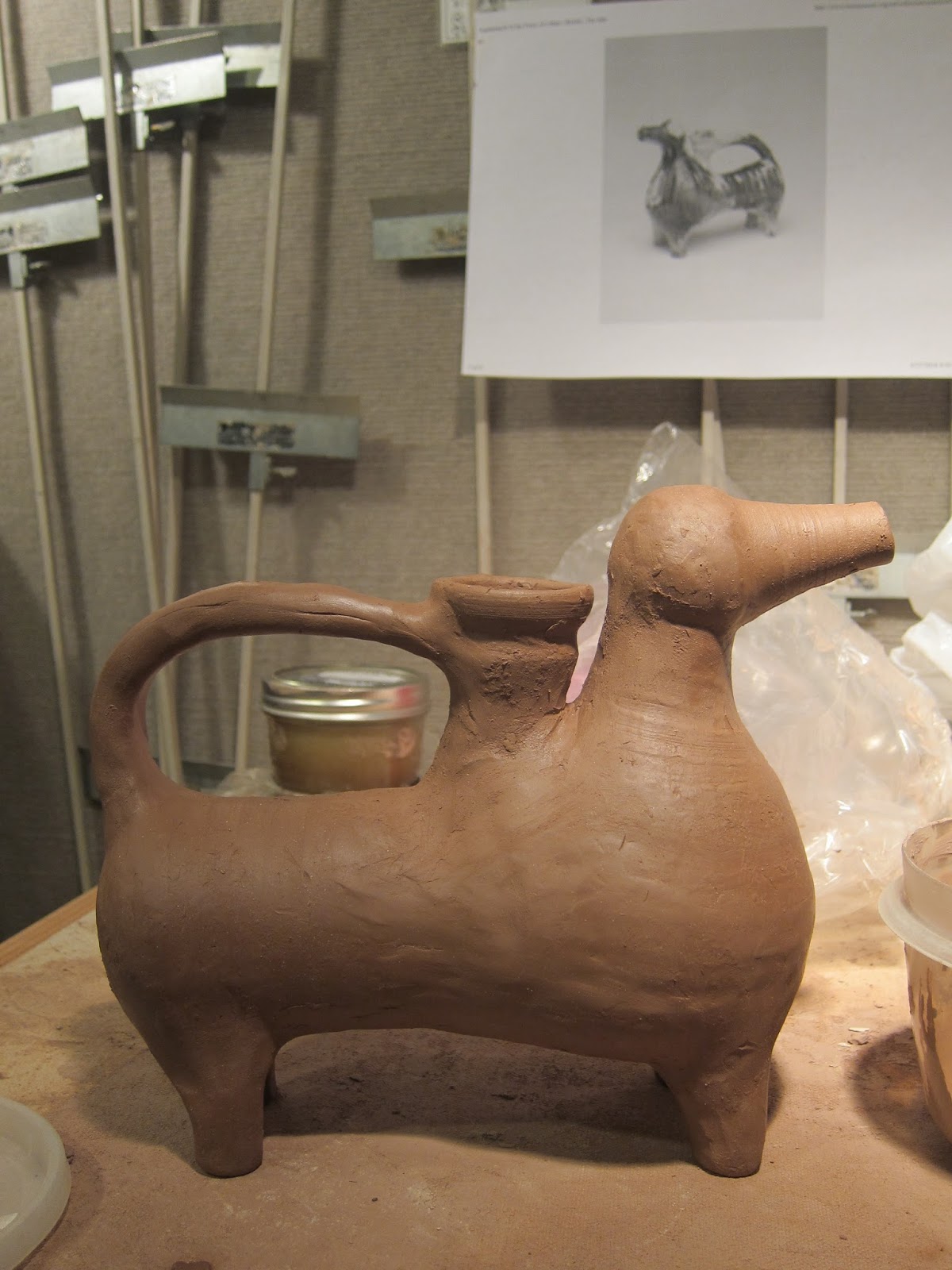
Throw two pieces on a wheel; a larger tubular vase and a smaller bud vase. Wrap loosely in plastic and let dry to leather hard overnight.


Line up the bud vase with the edge of the main body, and inscribe and then cut out the inside piece.


Score and cover with slip (diluted clay that serves as glue), press well together, and sculpt into one piece.

 
Carefully roll legs, measure into similar lengths, and attach to main body with the score and glue method. I also added a small roll of clay around the base of the leg for extra strength (plus it matches the flared silhouette of the original legs). Make sure not to trap any pockets of air anywhere as those can cause explosions when fired.


When the legs are attached, wrap loosely in plastic (in medieval times it would be wrapped in damp cloth) and rest overnight. The original only has the front legs, the back ones probably broke off from the weight of shifting dirt while being buried.

 
When the legs are nice and firm and support the body well, start working on the head. I did not throw the head as it is relatively small, instead I made a pinch pot in the right shape. Remove the part that is at the neck opening, and use the score and glue method to secure everything together.


I rolled two antlers of similar size and the right length and sculpted them to the back of the head. I used a piece of semi dry clay to help keep the wet clay from sagging. I used the score & glue method to stick the two antlers together, it would also be plausible to make one flat antler and carve it into two separate staves. I then cut a hole in the rear and worked the ends of the antlers around it to disguise the edge.
Then I glued on and sculpted the small horns on the antlers, and finished the rear water intake. From the museum photograph it is hard to see for sure where the water intake should be, and after careful consideration of the design I decided this would be the most likely place. 


As shown on the extant piece, I then added ears, chest flap, a mouth and eyes with eyebrows.


The Stag was bisqued. To emulate the orange tint glaze I used iron oxide under a white glaze for the body, with no iron oxide for the antlers.


Even though white glaze does not match the original clear glaze as much as I would have liked, the finished Stag Aquamanile emulates the look and function of the original nicely, and is a pleasure to look at and use.
 
 My interpretation bisqued and glazed. I used iron oxide under a white glaze.   

   The original, as photographed by the Victoria & Albert Museum, London.


. : The Finished Piece : .


Bibliography
  

Heise, Jennifer (2007) Hygiene of the Middle Ages and Rennaissance, Volume One: Personal
Grooming The Compleat Anachronist #136

Metropolitan Museum of Art (MET): Medieval Aquamanilia
http://www.metmuseum.org/toah/hd/aqua/hd_aqua.htm
St. Thomas Guild: Medieval Table Manners.
http://thomasguild.blogspot.com/2013_10_01_archive.html

Virginia & albert Museum (VA): Stag aquamanile
http://collections.vam.ac.uk/item/O9254/aquamanile-unknown/

Some thoughts on the construction of the Stag Aquamanile from the VA.


Reconstructing aquamanilia from museum photographs is not straight forward. The images available tend to be minimal, especially with the Stag which was photographed only in straight profile. As in this case not all details are visible, and no detail is shown from a top view, reconstruction of the handle requires a bit of guesswork and a lot of careful scrutiny of the original image. The questions in this reproduction would be as follows: as aquamanilia are expected to have two water holes, a small spout and a larger intake, where would the intake be? Is the handle made of one antler with one row of points, as it would seem from the single row visible, or two?

Single antler and no water-intake hole Stag Aquamanile interpretation:


I disagree with this interpretation for the following reasons:


About the antlers: I think there are two staves with two rows of points. There is a slight highlight [1] on the bottom of the front antler with a darker line behind it and I think that darker line is the bottom of the back antler, indicating there are two staves.


Detail from the original VA image.


There is one row of antler points visible. I think that is coincidence: the top two happen to have been broken off at some point and the lower ones happen to be hiding behind the front antler (like they are in the photograph of my reproduction). Two oval break points are visible at [2] and [3], the right shape for a point and most telling: missing the glaze.


About the water intake: Aquamanilia are supposed to have both a spout and a water in-take, but where is it here? The only place that makes sense would be at the bottom of the antlers, hiding in between. Therefore I interpret the bump at [5] to be the top rim of the water intake, hiding behind the two horizontal last antler points [4], one on each side (another reason to need two antler staves). From the very similar profiles on my version and the original version I am fairly confident this interpretation makes the most sense. 


Mine seems to be bit chunkier as the original as I am not proficient at throwing thin, plus I worried too small of a footprint for the bottom antlers, which doubles as a handle, would break too easily.


 The finished interpretation; top view.
 
Ready for first use, with it’s matching bowl.


Bibliography


Heise, Jennifer (2007) Hygiene of the Middle Ages and Rennaissance, Volume One: Personal
Grooming The Compleat Anachronist #136

Metropolitan Museum of Art (MET): Medieval Aquamanilia
http://www.metmuseum.org/toah/hd/aqua/hd_aqua.htm

Metropolitan Museum of Art (MET): Stag aquamanile
http://collections.vam.ac.uk/item/O9254/aquamanile-unknown/

St. Thomas Guild: Medieval Table Manners.
http://thomasguild.blogspot.com/2013_10_01_archive.html

Waterdene, Chrestiennede: Facebook post Stag Aquamanile.
https://www.facebook.com/ChrestiennedeWaterdene/posts/950022085106635?theater

Friday, February 17, 2017

Of Boyling and Seething

A reevaluation of the common cooking terms in connection with brewing.

Recreating medieval brews in our modern times is a fun and tasty way to connect to our historic past. Unfortunately, having a deeper understanding about the chemistry involved in fermentation does not necessarily translate into an easier interpretation of medieval recipes. Our modern brewing methods and sanitary measures evolved, and the language and terminology used in brewing changed over the years as well. The arcane language of early medieval recipes often makes modern interpretations approximations at best, and modern brewers with their own interpretation of the same recipe make variations which sometimes differ slightly and sometimes quite a lot. For instance, in my own work to recreate two mead recipes, no 9 and 10 in V: Goud Kokery which is part of the 14th century manuscript Curye on Inglysch, I initially used the editors suggestions on how to interpret recipe 10 To make fyn meade & poynaunt. After half a dozen or so of mediocre variations, and a deepening puzzlement on the sequence of steps in the recipe, I realized the editors’ interpretation has practical issues. Expecting something off with the technique, instead of tweaking the recipe to make it fit our modern conceptions, I delved deeper into the practices used during our time of study to track down where it went off track.

The first step was to look into the source of the fermentable sugars in mead – the honey – which at the same time located the source for fermenting yeast. Medieval honey would have been available in different states and different grades. The highest grade honey was life honey, which is the honey that drips out first without any assistance and is highly regarded both in brewing and in medicine. Life honey is honey which is completely untreated, and held in such high esteem that in medieval Dutch cooking and brewing recipes it had its own term ‘zeem’. The translation for ‘zeem’ is given as ‘ongepijnde honing’, unhurt or unprocessed honey and also as ‘maagden honing’, or virgin honey. Unfortunately, true to medieval practice, the word is used interchangeably for life honey and high quality processed honey, and it is up to the reader to interpret which ingredient is meant. (openlaszlo) What makes life honey so special, and literally alive, is that even though honey is antibacterial, it is a welcome host for osmophillic yeast strains like Saccharomyces rouxii, Sacharomyces var. osmophilus and Sacharomyces bisporus var. mellis. (Rasmussen, 21)

Osmophillic yeast is able to thrive in highly concentrated sugar solutions, and is best for the fermentation of honey solutions with sugar concentrations above 15%, but generally does not produce alcohol as well as the common beer and wine yeasts. If sugar concentrations are below 15%, the wine and beer yeast varieties of Sacharomyces cerevisiae are the best choice for optimally fermenting honey. (Rasmussen, 21) When processing life honey temperatures exceeding 154 º Fahrenheit / 68 º Celsius (Hagen, 148) will kill ambient yeast and heating honey to facilitate flow often does not produce life honey. Also, like the term ‘zeem’, the term ‘life honey’ is sometimes used for true honey that is alive and will start fermentation, and sometimes for honey of the best quality. If the life honey asked for in a recipe is to be truly boiled, then it does not need to be alive honey and you should not sacrifice your labour intensive honey-yeast starter to literally emulate the medieval recipe. One thing to keep in mind when fermenting with osmophillic yeast: as the starting sugar concentration or density is high it will have a slow start, especially compared to pitching modern concentrated yeast.

Processed honey is graded depending on how it is removed from the comb: with unprocessed life honey being first grade, second grade would be what would easily be leaked out and strained when breaking up or crushing the comb cell structure (equivalent to our centrifugal extracted honey), third grade would be washing the leaked combs in heated water whereby the leftover and crystallized honey dissolves but the wax is not melted, and then a waste grade would be to squeeze the washed combs with a twisted bag press to get the last little bits of liquid out (often used for servant grade). This is not recommended by the reverend Charles Butler, who warns in his 1609 beekeeping treatise Feminine Monarchie: “& some (which is worse) doe violently presse it out. But by these means they shal have no fine & pure raw hony, howsoever afterward they handle it.
Leaking can be facilitated with heat, and as long as the radiant temperature is kept below 154 º F the ambient yeast would survive. Leaked honey would be used in recipes calling for volumes or weights. Honey from different bio-regions or different seasons (a wet spring, a dry fall, etc) can have different sugar concentrations, and when using volumes or weights, can lead to slight differences in sugar concentration, as the Digby recipe Mr. Pierce’s Excellent White Metheglin confirms “When it is blood-warm, put the honey to it, about one part, to four of water; but because this doth not determine the proportions exactly (for some honey will make it stronger then other) you must do that by bearing up an Egge”.
Washing can be facilitated by agitation by hand, which would also keep the water temperature in check to make sure it is not hot enough to melt wax (upwards of 144 ºF or 62 ºC). Coincidentally, if honeycomb is warmed enough to dissolve the sugars but not enough the melt the wax, the ambient yeast is able to survive to start fermentation. As the sugar concentration of washed honey is unknown – not enough honey will make weak mead which spoils much quicker, while too much honey can inhibit yeast growth giving competitors a change – it is advisable to use a hydrometer to check gravity (the amount of sugar in solution); either with a modern glass hydrometer, or with the egg float test, which basically does the same thing but with a renaissance flair.

A honey solution made by boiling scraped honeycomb. The swirls are from particulated bees wax.
The position of the egg showing about 20 mm or the size of a medieval groat coin above the surface
indicates enough dissolved sugars for a circa 12% alcohol mead.

The next step is to look into the cooking process: how exactly did the honey become must. Many medieval recipes will advice to boil the must. Since the source of medieval water is most often rather conspicuous, up to the point of deadly, this is not persé a bad thing. For the flavor of the honey it would be better to boil the water first, and add the honey when it is blood-warm to then start fermentation. Alcohols’ preservative properties combined with the antibacterial effect of honey makes for a safe product to drink, much saver than surface water, even without boiling. According to Feminine Monarchie, heating above temperatures which would hurt the skin “The best way is to put it into an oven after the batch is forth, but not before you can abide to hold your hand upon the bottome, for feare of overheating the hony” is known to damage the honey. Maybe, even though in cooking recipes the word ‘boil’ is most often meant as a roiling boil, in brewing it might mean the process of cooking? Unless refermentation during warm weather is meant, to confuse the matter even more! As Hugh Platt in his 1594 Jewell House of Art and Nature complains “If any sweete Wines happen to reboile in the hot part of the Summer, as manie Vinteners to their great losse have oftentimes felt”.
The word ‘seethe’ or ‘seething’ is even vaguer. Does it mean simmering, or, being at a boil but not bubbling? Or does it mean the process of heating, which could be anything from above room temperature to near boiling? For instance, the recipe To Make Mede in the 14th CE Curye on Inglysch cookbook uses both ‘boil’ and ‘seethe’& thanne take that forseid combis & sethe hem in clene water, & boile hem wel” but after all that the combs should still be intact enough to be pressed out “After presse out thereof as myche as though may”. This indicates the water temperature did not actually exceed 144° F or 62 ºC and melt the wax. Thus instead of translating the following quote to “take the previously mentioned combs & simmer them in clean water, & boil them well”, should it perhaps be “take the previously mentioned combs & heat them in clean water, & cook them well”? Since the latter interpretation matches the Feminine Monarchie’s technique “set it in some vessel over a soft fire, and stil keep your hand in the vessel stirring about the honie and the wax, and opening the wax piece-meale until the hony and not the wax shal be molten”, and it makes sense, I think this would be the correct interpretation. And as ambient yeast survives heating up until 154 ºF or 68 ºC this would mean the must is still viable for spontaneous fermentation, without the need for adding barm or lees from a previous batch.

Back to the two recipes, interpretations of the translation is re-evaluated. The reason I work with both recipes is that recipe 10 looks back to recipe 9, even more so in the re-evaluation than I initially had thought.

The two original recipes and the proposed alternate interpretations:

9 To make mede.
Take hony combis & put hem into a greet vessel & ley thereynne grete stickis, & ley the weight theron til it be runne out as myche as it wole; & this is called liif hony. & thanne take that forseid combis & sethe hem in clene water, & boile hem wel. After presse out thereof as myche as though may & caste it into another vessel into hoot water, & sethe it wel & scome it wel, & do therto a quarte of liif hony. & thanne lete it stone a fewe dayes wel stoppid, & tis is good drinke.    (Hieatt & Butler, 150)
Literal Translation:

9 To make mead.
Take honey combs, and put them into a big vessel & lay in there big sticks, & lay the weight on it until it runs out as much as it would; & this is called life honey. & then take those mentioned combs & simmer them in clean water, & boil it well. After press out of it as much as you can & cast it into another vessel into hot water, & heat it well, & scum it well, & do thereto a quart of life honey. & then let it stand a few days well closed up, & this is a good drink.    

If the honey combs are literally simmered and boiled, the wax will melt into the sugar solution. Interestingly, while the combs are quite bulky in their solid state, once they are melted within the sugar solution there is not a whole lot left. In one of my experiments, the combs were boiled in clean water and poured through a cheesecloth filter while hot, and in another experiment the combs were boiled, the must was cooled down first, and then poured through a cheesecloth filter. Filtering the waxy must while hot particulized the hot wax, which then solidified in tiny particles which mostly stayed suspended in the must. During fermentation a thin film of wax particles formed on the surface, which created quite a nice surface protection. After bottling the wax particles would form a haze around the neck of the bottle (shake well before pouring) and while sipping there was a distinct sensation of lipbalm around the lips. Many of these issues were negated by filtering the wax must after cooling down, though the sensation of lipbalm never completely went away. For the amount of wax comb that went into the must and the insignificant amount that was recovered during filtering, the indication is most stayed in solution with the sugars. Boiling the wax to dilute the honey does not coincide with the available information (as in, there should be comb structure left to be pressed) plus, the wax adds a significant (although not unpleasant) taste to the must.

     Boiling the wax comb and honey to make the must. From the 4 scraped frames of honey comb only about
an inch worth of black gook was recovered. Most of the bright yellow wax disappeared during the boil.


Current Interpretation:

9 To make mead.
Take honey combs, and put them into a big vessel & lay in there big sticks, & lay the weight on it [of the combs] until it runs out as much as it would; & this is called life honey. & then take those mentioned combs & heat them in clean water [not hotter than your hands can take], & cook it well. After press out of it [the combs] as much as you can & cast it [the liquid] into another vessel into hot water, & heat it well, & scum it well, & do thereto a quart of life honey. & then let it stand a few days well closed up, & this is a good drink.   

The second recipe:

10 To make fyn meade & poynaunt.
Take xx galouns of the forseid pomys soden in iii galouns of fyn wort, & i galoun of liif hony & sethe hem wel & scome hem wel til thei be cleer enowgh; & put therto iii penyworth of poudir of peper & i penyworth of poudir of clowis & lete it boile wel togydere. & whanne it is coold put it into the vessel into the tunnynge up of the forseid mede; put it therto, & close it wel as it is aboue said.    (Hieatt & Butler, 150)

Literal Translation:

10 To make fine mead & poignant.
Take 20 gallons of the previously mentioned pomys cooked in 3 gallons of fine wort, & take 1 gallon of life honey & simmer it well & scum it well until it is clear enough; & add to it 3 pennyworth powder of pepper & 1 pennyworth powder of cloves & let it boil well together. & when it is cold put it into the vessel of the barreled up previously mentioned mead; add it to it, & close it well as it is said before.   

The suggestions by Hieatt & Butler are as follows:
The word ‘pomys’ translates as apples (p. 207). [This exact word only shows up once as part of V: Goud Kokery; variants from other recipes are ‘poumes’ and ‘pommys’ which both refer to a softened apple dish.]

The ‘forseyd pomys sodden’ evidently refers to a recipe the scribe has omitted (p. 150)

Fyne meade and poynaunt V 10, spiced mead. Despite the initial directions, no recipe calling for cooked apples actually occurs in the vicinity of this one. The quantity of spices called for would work out to something like 2 oz. of pepper and ¼ oz of cloves: this would not make a very spicy drink, considering the 34 [edit 24] gallons of other ingredients. (p. 188)

The immediate issue with recipe 10 is the translation of the word ‘pomys’. From its similarity to the word ‘pommys’ it seems self evident it would refer to apples (linguistically via the French word ‘pomme’ for apple). The word ‘pomys’ in modern times could translate to ‘pomace’ or apple pressings, the apple solids left over from the making of cider, or apple juice. To my best knowledge, the word ‘pomace’ is never used for the juice, always for the leftover solids from pressing, so I am inclined to forgo the option of it meaning juice, or the must from recipe 9.

Another issue is the meaning of the word ‘tunnynge’, which I’d like to address first. The word ‘tunnynge’ can be interpreted as either a measurement (a ‘tun’ or a barrel of 252 or 265 gallons, a defined unit of volume in the 14th century) or an action (tunning). My first trial used the tun as a measurement and found that it adds too much volume to the amount of honey & malt for a proper ferment. The recipe instructs “put it into the vessel into the tunnynge up of the forseid mede” which at first reads like it barrels up twice: “put it into the vessel into the tun of the previously mentioned mead”. My current interpretation is “put it into the vessel into the tunned up previously mentioned mead”, or, use a transporting vessel (see image) to move the wort/must and add it back “put it therto” into the barrel of the mead made with recipe 9. This would indicate recipe 10 is not a stand alone recipe, but instead uses the mead made in recipe 9 to make something else, called fyne meade and poynaunt. This would basically make a braggot, except instead of adding honey & spices to ale to re-ferment (as a typical period braggot), it adds wort (malt) and spices to mead (akin to a modern braggot, or malted mead).

“The Brewer” by Jan Luyken (1649-1712)
The vessel mentioned in the recipe could be used to transport from the boiling vat to the fermenting tun or barrel.

Back to the pomys. Hieatt & Buttler assume “the ‘forseyd pomys sodden’ evidently refers to a recipe the scribe has omitted” as “despite the initial directions, no recipe calling for cooked apples actually occurs in the vicinity of this one”. When the directions in recipe 10 are interpreted as if ‘pomys’ meant apple, to make a spiced apple wine sweetened with honey and wort/malt, the ratio of solid apples and fermentable sugars to liquid does not seem to add up. To properly ferment a certain amount of apple solids, it would need to be at least submerged, which combined with the direction to cook it “soden in iii galouns of fyn wort” makes for apple sauce consistency. If enough water is added to create an acceptable cooked apple wort the amount of fermentable sugars is too low for a proper ferment, and if the water ratio is balanced for a proper short mead ferment, the must is so dense it is difficult to get a good ferment (and have liquid left over at the end, the apple solids suck it up like a sponge). This recipe had a tendency for the apple sauce to create a pancake at the surface which then would get pushed up by fermentation gasses, straight out through the airlock, which necessitated in stirring the must back down every other hour or so until primary fermentation slowed down. In other words, the recipe does not make sense, it does not work well, and the resulting brew would spoil prematurely on a regular base, indicating a unbalanced recipe. Combined with the interpretation that recipe 10 could be a back ferment of recipe 9, similar to a modern braggot, it puts the translation of ‘pomys’ to apple to serious question.

 Before fermentation (L) and after fermentation (R). One quart of apple solids added to one gallon of water, with appropriate honey and malt. Cooking made the apple fall apart and most of the available liquid became absorbed.

What could be meant instead? If “the forseid pomys sodden” is to be taken literally as something cooked from the previous recipe, then let’s look back to see what fits. The bulk honey from recipe 9 does not come from leaked honey but from washed out wax comb: “& thanne take that forseid combis & sethe hem in clene water, & boile hem wel”.  When the alternate interpretation for ‘seething’ and ‘boiling’ is used, the directions to “heat them in clean water, & cook them well” would generate left over wax combs, which are then “presse out thereof as myche as though may”. If the alternate interpretation is not used, and the must is literally simmered and cooked, then the wax would have melted and there’d be nothing left to be pressed, strongly indicating lower temperatures than the melting point of wax. The wax comb from recipe 9 is both cooked and pressed it would fit the description of “the forseid pomys sodden” of recipe 10 perfectly (Magnus).

Current Interpretation:

10 To make fine mead & poignant.
Take 20 gallons of the previously mentioned pomys [the squeezed combs of recipe 9] cooked in 3 gallons of fine wort, & take 1 gallon of life honey & heat it well [below 154 ºF, and the ambient yeast will survive] & scum it well until it is clear enough; & add to it 3 pennyworth powder of pepper & 1 pennyworth powder of cloves & let it cook well together. & when it is cold put it into the vessel of the barreled up previously mentioned mead [add it back into the barrel the 20 gallons came out off]; add it to it, & close it well as it is said before.  

Twenty gallons of pressed comb cooked in 3 gallons of malt seems like a too small ratio of solid to liquid. Unexpectedly, I found from experience that boiling comb in a sugar solution does not generate a significant amount of melted wax and as the combs are probably also somewhat wet, even after manual pressing, they could conceivably have some crystallized honey remnants left to add to the must. When the combs are boiled in the wort/must the scum will float to the top, just like with clarifying honey, and would have to be removed “scome hem wel til thei be cleer inowgh” at the same time. And while Hieatt & Butler thought the small quantity of pepper and cloves “would not make a very spicy drink”, adding boiled wax combs to the mix significantly changes the taste of the mead (mead made with honey in which wax has been boiled has a very distinctive spicy, earthy taste).


Conclusion.

The translation of the two Curye on Inglysch mead recipes by Hieatt & Butler, even though not completely understood, theoretically makes sense. It took some dedicated experimental archaeology, so to speak, to come to the conclusion the modern interpretation did not add up and a different way of thinking was needed. Instead of looking at individual recipes as singular snippets, sometimes it’s necessary to see a recipe within a broader historical context. For example, the cooking technique blanching historically meant soaking in cold water until the almond skins came off, while in modern times it means pouring over boiling water until the almond skins come off. While the end result seems the same, almonds soaked with the modern method tends to make dry crumbly marzipan, while cold soaked almonds makes great sticky marzipan, just like grandma used to make. I learned not to assume just because a word or technique had a modern equivalent, it therefore historically meant the same. While seething and boiling might actually mean simmering and boiling in one recipe, when dealing with brewing recipes I now tend to double check (is there wax involved? What happens to the life honey?). When emulating a historic recipe, I look for similar recipes and check if there are nuances to the techniques & ingredients used; it might explain something I did not even realize might be questionable. And just because something was written down eight hundred years ago does not make it infallible: people make mistakes, especially with the older texts the artisans were not the scribes; translators made errors, as recipes would be translated and republished (no medieval copyright), and some people are just better brewers than others.

When interpreted within a broader context, the two Curye on Inglysch mead recipes work surprisingly well and work well together. Recipe 9 makes good basic mead and includes detailed albeit cryptic information on the processing of the comb, which is omitted by many later period mead recipes. For now - until new information presents itself - recipe 10 seems to be meant as an addition to a barrel of mead made with recipe 9, to back sweeten and spice up mead with boiled beeswax comb, for just that special occasion. And who’d have thought that…


Want to read more? Check out my (newly updated) brewing paper Of Hony, a collection of Mediaeval Brewing Recipes, listing 46 period mead recipes, on Academia.edu at:
https://www.academia.edu/31052051/Of_Hony_-_A_collection_of_Mediaeval_brewing_recipes

References:

Butler, Charles. The Feminine Monarchie. 1609. Oxford: 1623.
https://books.google.com/books?id=f5tbAAAAMAAJ&dq=the+feminine+monarchie+butler&source=gbs_navlinks_s Transcription by Susan Verberg.

Digby, Kenelme. The Closet of the Eminently Learned Sir Kenelme Digby Knight Opened, 1669
The Project Gutenberg EBook of The Closet of Sir Kenelm Digby Knight Opened. Anne MacDonell (ed.), 2005 https://www.gutenberg.org/ebooks/16441

Hagen, Ann. A Second Handbook of Anglo-Saxon Food and Drink: Production and Distribution. Norfolk, UK: Anglo-Saxon Books, 1995.

Hieatt, Constance B. & Butler, Sharon (ed). Curye on Inglysch, English culinary manuscripts of the 14th century (including the Forme of Cury). Early English Text Society. London: Oxford University Press, 1985.

Private communication with Peter Olson (East Kingdom brewing Laurel lærifaðir Magnus hvalmagi).

Rasmussen, S.C. The Quest for Aqua Vitae. SpringerBriefs in History of Chemistry, 2014.

Verberg, Susan. Of Honey, a Collection of Mediaeval Brewing Recipes. 2017.
https://www.academia.edu/31052051/Of_Hony_-_A_collection_of_Mediaeval_brewing_recipes

Links:
http://gtb.inl.nl/openlaszlo/my-apps/GTB/Productie/HuidigeVersie/src/inlgtb.html?owner=MNW

Images:
Protz, Roger. The Ale Trail. Eric Dobby Publishing, 1995, p. 30
All photography © by Susan Verberg.